When it comes to outfitting a commercial facility—be it a hotel, hospital, or school—the choice of storage equipment often comes down to a balance between initial investment and long-term durability.
Among facility managers and procurement specialists, one of the most debated topics is the material choice for janitorial storage: Grade 201 vs. Grade 304 Stainless Steel. While both look nearly identical to the naked eye, their performance in professional environments varies significantly.
In this guide, we will break down the chemical differences, environmental suitability, and total cost of ownership to help you decide which material offers the best value for your specific project.
1. Understanding the Chemistry: 201 vs. 304
To understand why one cabinet costs more than another, we have to look at the metallurgy. Stainless steel is an alloy, and the “Grade” refers to the proportion of elements like Chromium and Nickel.
Grade 304: The Industry Standard
304 stainless steel is the most versatile and widely used grade. It contains high levels of Chromium (18%) and Nickel (8%). Nickel is the expensive ingredient that provides superior corrosion resistance, especially against chlorides and acids.
Grade 201: The Cost-Effective Alternative
201 stainless steel was developed as a lower-cost alternative to 304. It replaces much of the expensive Nickel with Manganese and Nitrogen. While it remains strong and durable, it is more susceptible to pitting and rusting in high-moisture or chemically aggressive environments.
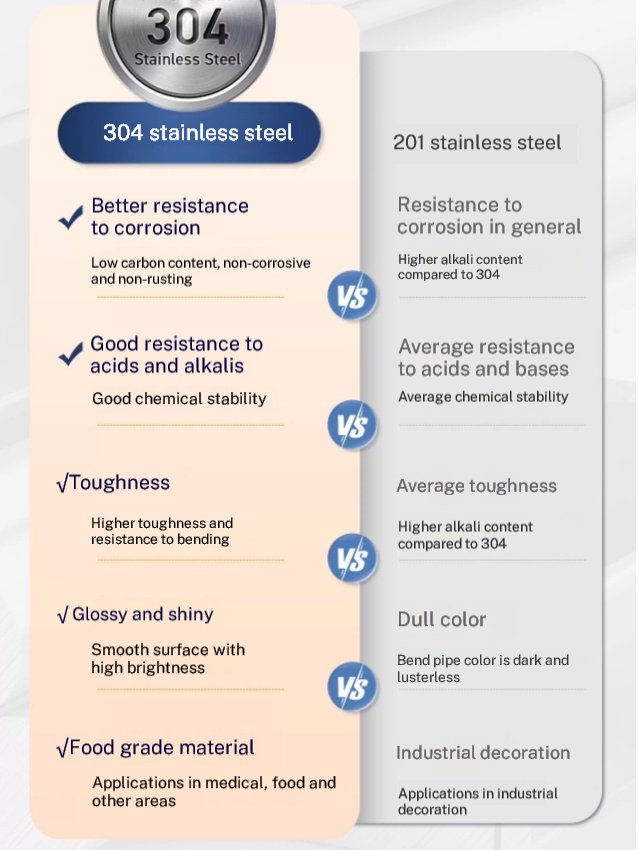
201 vs. 304 Stainless Steel Janitorial Cabinets At-a-Glance Comparison Table
| Feature | Grade 201 Stainless Steel | Grade 304 Stainless Steel |
| Corrosion Resistance | Moderate (Best for dry interiors) | High (Resists moisture & chemicals) |
| Durability | High (Harder than 304) | High (Tough and ductile) |
| Price Point | Economical (Budget-friendly) | Premium (Higher initial cost) |
| Typical Lifespan | 5–10 years (Environment dependent) | 15–25+ years |
| Common Use Case | Schools, Offices, Dry Storage | Hospitals, Kitchens, Coastal Areas |
2. When to Choose 201 Stainless Steel Janitorial Cabinets
For many B2B buyers, Grade 201 is the “sweet spot” for value. If your facility is located inland and the cabinet will be placed in a temperature-controlled, dry environment, 201 offers incredible strength at a fraction of the price.
Key Benefits for B2B Buyers:
- Budget Optimization: For large-scale projects (like a school district with 20+ buildings), the cost savings of 201 over 304 can be redirected to other essential equipment.
- Surface Hardness: 201 is actually harder than 304, meaning it resists scratches and dents from heavy mops and vacuum cleaners slightly better in high-traffic areas.
- Professional Aesthetic: It maintains the same sleek, modern look as 304, ensuring your back-of-house areas look clean and organized for facility audits.
Best For: Office buildings, dry storage rooms in schools, and indoor retail janitor closets.
3. When to Upgrade to 304 Stainless Steel
While 201 is excellent for dry areas, certain “High-Stress” environments demand the chemical stability of Grade 304.
The “High-Moisture” Rule
If your janitorial cabinet will be stored in a communal shower area, a poolside maintenance room, or a commercial kitchen where floors are frequently hosed down, 304 is mandatory. The constant exposure to humidity will cause 201 to develop “tea staining” (surface rust) over time.
The “Chemical” Factor
Cleaning staff often handle concentrated bleach, sanitizers, and acidic descalers. In hospitals or laboratories where medical-grade disinfectants are used daily, 304 stainless steel prevents the chemical “pitting” that can compromise the structural integrity of the cabinet.
Best For: Hospitals, commercial kitchens, coastal resorts, and industrial chemical plants.
4. The Juntuo Design Advantage: More Than Just Metal
At Luoyang Hengna Office Furniture, we know that material is only half the battle. Whether you choose 201 or 304, a janitorial cabinet must be designed for the realities of the job.
Why Our HNQJ51ig Series Outperforms the Competition:
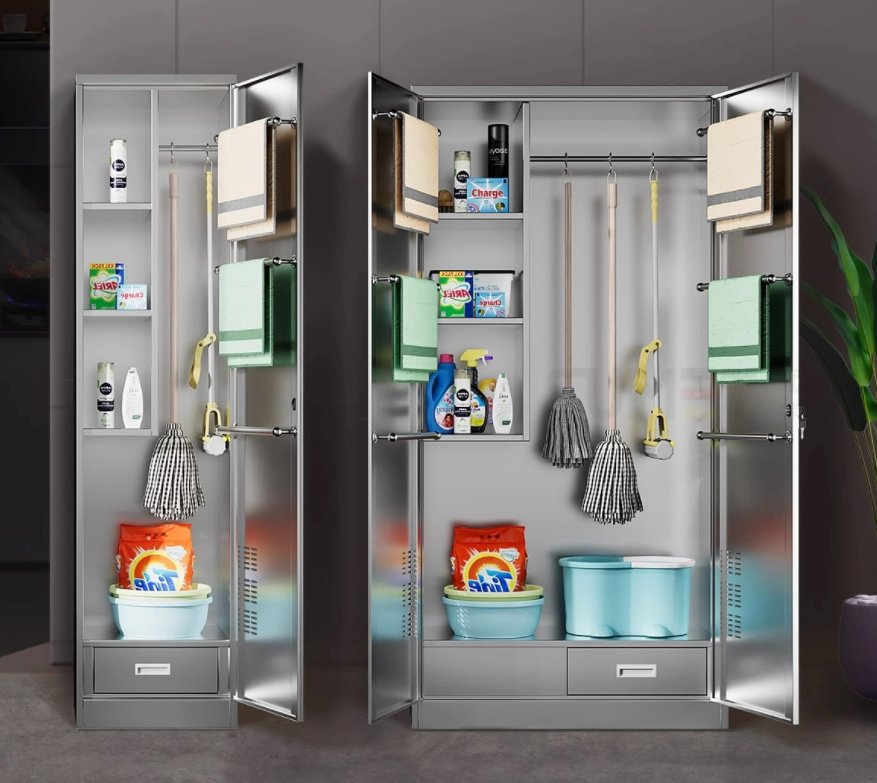
- Ventilation is Essential: Moisture is the enemy of metal. Our cabinets feature integrated louvers that allow damp mops to air-dry, preventing odor and rust.
- The Modular “Knock-Down” (KD) Factor: We ship our units in flat-packs. For B2B wholesalers, this means you can fit 3x more units in a single shipping container, slashing your landed cost per unit.
- Secure Internal Storage: Most janitorial staff carry personal items or need to secure expensive chemical concentrates. Our built-in locked drawers provide that extra layer of security that standard lockers lack.
5. Maintenance Tips to Prolong Cabinet Life
Regardless of the grade you choose, simple maintenance can double the lifespan of your storage units:
- Use the Drip Tray: Ensure wet mops are placed in the drip tray, not directly on the cabinet floor.
- Avoid Steel Wool: Never clean stainless steel with steel wool, as it leaves carbon steel particles that will rust. Use microfiber cloths.
- Check Ventilation: Ensure the cabinet isn’t blocked by boxes, allowing the air vents to function.
6. Which is the Best Value?
The “Best Value” is the grade that meets your environment’s demands without overspending.
- Choose 201 if you are managing a standard office, school, or dry commercial space. It offers the best “Price-to-Performance” ratio.
- Choose 304 if you are in the medical, food service, or maritime industry where hygiene and corrosion resistance are non-negotiable.
Partner with a Professional Manufacturer
At Luoyang Hengna Office Furniture Co., Ltd., we specialize in helping B2B clients find the perfect storage balance. From our Juntuo HNQJ51ig Series with dual wall-mount/floor-standing options to fully customized OEM dimensions, we provide the hardware that keeps your facility running smoothly.