Tools scattered all over the workshop floor? Spent ten minutes looking for a wrench that should’ve been right there? Shelves warping after just a few months? If any of this sounds familiar, you’re not alone — plenty of factory buyers have been down this road.
A solid tool cabinet might not be the most exciting purchase on your list, but it directly affects how fast your team works and how safe your shop floor stays. Get it right, and tools stay organized, easy to find, and protected for years. Get it wrong, and you’re dealing with sagging shelves, stuck drawers, and a wobbly cabinet that cost real money but can’t handle the job.
Here are the 7 most important things to look at when choosing a heavy-duty tool cabinet — straight from real workshop experience, not a marketing brochure.
1. Structural Integrity and Steel Grade
Your tool cabinet takes a beating every single day. If the material can’t handle it, nothing else matters.
Most industrial-grade tool cabinets are built from cold-rolled steel. Compared to hot-rolled steel, cold-rolled steel has a smoother surface, higher tensile strength, and better corrosion resistance. It’s the baseline for anything that calls itself “industrial duty.”
But steel thickness alone doesn’t tell the whole story. Structural design is just as critical. A well-built cabinet reinforces high-stress areas — the frame is formed from a single bent panel rather than welded pieces, shelves have support ribs underneath, and reinforcing beams connect the back panel to the side panels. These details determine whether the cabinet holds up under years of heavy use or starts falling apart after one.
Buying tip: Always ask about steel thickness and construction method. Avoid cabinets with thin-gauge steel or bolted-together frames. Not sure what to look for? Send us your workshop details and we’ll point you to the right spec.
2. Load-Bearing Capacity: Look Beyond the Specs
A lot of manufacturers list impressive weight ratings on paper, but the shelves still warp within months. Why? Because load capacity isn’t just about steel thickness — it’s about how the shelf is supported.
Shelves that actually hold up under heavy loads share a few design traits:
Support ribs or reinforcing beams underneath the shelf to distribute weight evenly
Multi-point locking between shelves and uprights, not just resting on ledges
One-piece stamped drawer bottoms rather than thin folded edges
The thing is, every workshop is different. A shop full of hand tools has very different load requirements than one storing pneumatic wrenches and electric drills. Rather than guessing from a spec sheet, it’s worth telling your supplier exactly what you plan to store — they can recommend the right capacity for your situation.
The easy way: Contact us with your workshop environment and tool types. We’ll match you with the right load rating so you don’t end up underbuying or overspending.
3. Specialized Storage Modules: Pegboards and Bins
A tool cabinet isn’t just a box to shove things into. The real test is whether your team can find what they need in seconds.
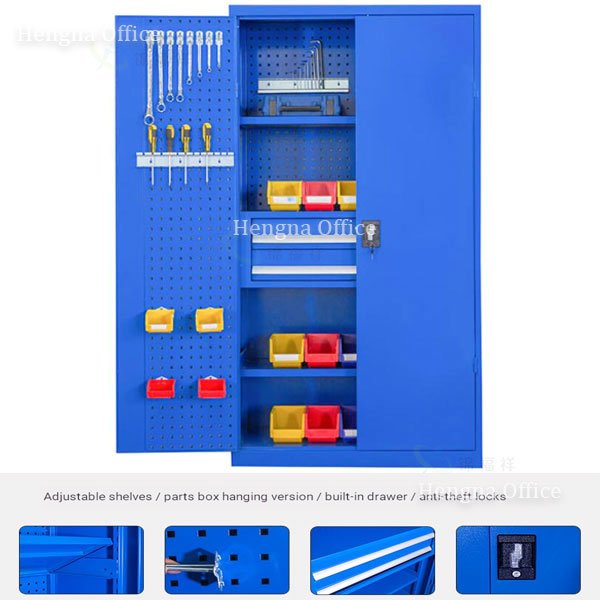
One of the most practical setups available right now is the pegboard door + parts bin combination. A perforated pegboard mounted on the inside of the cabinet door lets you hang wrenches, screwdrivers, hex keys, and other frequently used tools right where you can see them. Pair that with small parts bins in various sizes, and loose hardware like screws, nuts, and washers finally stays organized instead of turning into a junk drawer.
Look for cabinets that include or offer these storage accessories:
Adjustable pegboards with flexible hole patterns for different tool types
Color-coded parts bins for quick visual identification
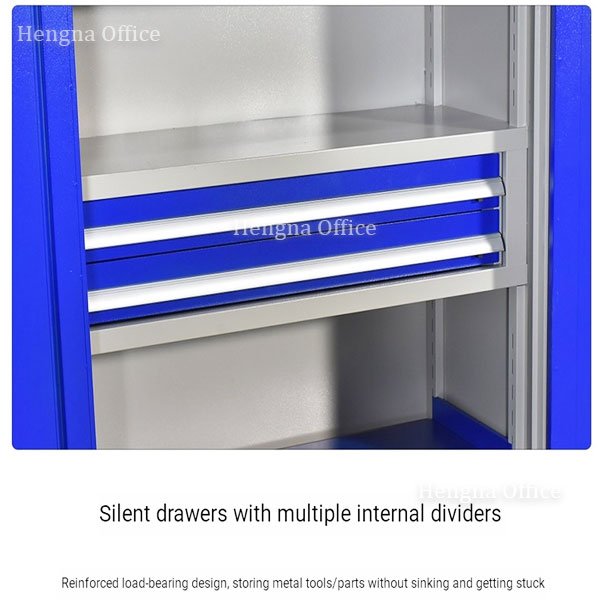
Internal drawer dividers that let you create custom compartments and keep tools from banging into each other
This kind of setup effectively doubles your storage surface — the inside of the door, which is normally wasted space, becomes an entire tool wall.
4. Ergonomics and Silent Operation
Workshops are noisy enough without drawers slamming around. But noise isn’t the only issue — low-quality drawer slides lead to drawers that stick, won’t close properly, jam halfway, or even jump off their tracks.
Silent drawer slides (typically three-section ball-bearing slides with dampers) are standard on mid-to-high-end tool cabinets. Good slides share these characteristics:
Smooth, one-hand operation
Soft-close mechanism that prevents slamming and pinched fingers
Even weight distribution — no sagging even when fully loaded
No loosening or rattling after extended use
It’s also worth paying attention to adjustable drawer dividers. Precision instruments like micrometers and calipers can lose accuracy if they’re tossed into a drawer loose. Dividers create separate zones so each tool has its own dedicated spot.
5. Security and Anti-Theft Features
In most factory settings, tool cabinets are shared among multiple workers. Tool loss is a real and recurring problem. A decent lock system saves a lot of headaches.
Keep these points in mind:
Lock quality: Go for key-operated locks, not simple toggle latches
Number of locking points: A single-point lock only secures the middle of the door. Two-point or three-point locks engage the top and bottom simultaneously, making pry attacks much harder
Hinge type: Exposed hinges are vulnerable to tampering. Concealed hinges are far more secure
Overall rigidity: Even the best lock is useless if the cabinet itself can be pried open
For cabinets storing expensive tools or precision instruments, consider adding transparent door panels — they provide security while letting you do a quick visual inventory check without unlocking.
6. Dimensions and Modular Scalability
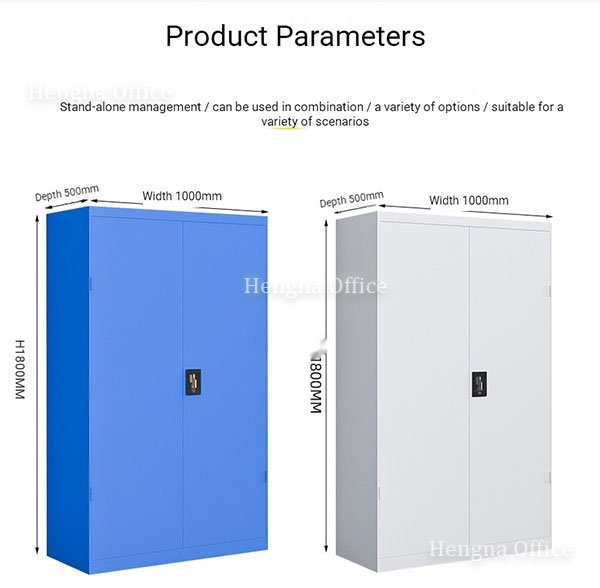
The most common standard size for industrial tool cabinets is 1800mm (H) × 1000mm (W) × 500mm (D). This dimension strikes a good balance between storage capacity and floor space, and it’s manageable for one person to operate.
But a truly useful tool cabinet system isn’t just about single-unit dimensions — it’s about whether you can scale up. Most workshops need more than one cabinet, and the best models support side-by-side installation with seamless joining to create a full tool wall.
When planning a multi-cabinet setup, check:
Whether the cabinet top is flat and sturdy enough for stacking or placing items
If connecting hardware is available for securing units side by side
Whether optional casters can be added for mobility and layout flexibility
Pro tip: Do a full inventory of your tools first — type, quantity, and estimated weight. Then decide how many units and what configuration you need. It’s better to get it right the first time than to add units later and find they don’t match.
7. Surface Treatment and Environment Resistance
Tool cabinets in real workshops deal with oil, cutting fluid, chemical solvents, and constant handling. If the surface treatment is subpar, you’ll see peeling paint and rust spots within a year or two.
Electrostatic powder coating is the industry standard for industrial tool cabinets, and it offers clear advantages over conventional wet paint:
Feature
Powder Coating
Wet Paint
Adhesion
Strong, resists peeling
Moderate, peels over time
Oil & Grease Resistance
Excellent, wipes clean
Poor, oil penetrates and stains
Corrosion Resistance
Superior rust protection
Fair, rusts in humid conditions
Surface Hardness
High, resists scratches
Low, tools leave marks easily
Environmental
Zero solvent emissions
VOC emissions during application
Quick test: scratch the surface lightly with a hard object. Powder coating will leave a shallow mark but won’t expose bare metal. Wet paint will chip and show the steel underneath.
Conclusion
Choosing a tool cabinet isn’t about spending more or chasing the highest spec sheet — it’s about matching the cabinet to your actual workshop needs. Here’s how the 7 factors rank by impact:
Material & Structure — determines how long it lasts
Load-Bearing Capacity — determines if it can handle your tools
Storage Organization — determines how fast your team finds things
Silent Operation — determines daily usability
Security Features — determines whether your tools stay put
Dimensions & Modularity — determines if you can scale up later
Surface Treatment — determines how easy it is to maintain
If you’re in the market for industrial tool cabinets but aren’t sure which specs matter for your situation, get in touch with us. Tell us about your workshop and what you need to store, and we’ll recommend the right model and configuration — no guesswork involved.