The most expensive thing on an assembly line is not the part. It is the walk.
Someone on the line needs a bracket, cannot find it at the line, and walks to the stores to look for it. Ten minutes later they come back with the right bracket and the wrong revision. Meanwhile the line kept running and the next operator started the same search. This happens every shift, and it never shows up in any report, because the report measures output and the walk is not output.
The fix is not more shelving in the stores. It is putting the material where the line actually uses it, in a position that signals what is missing.
What a line-side position has to do
It has to be at the line. Not near it, not beside the stores, not at the end of a aisle. Within arm’s reach of the operator who is about to need the part.
It has to signal. In a Kanban loop, the signal is usually the empty bin. The operator takes the last part out of a bin, the bin stays on the rack, and that empty bin is the signal to replenish. That only works if every bin holds one part type. Mixed bins break the signal, because nobody can tell what is missing.
It has to survive being moved. A rack on wheels that cannot be held in position is worse than a fixed rack, because it ends up in the walkway.
It has to hold the awkward stuff. Small fasteners, connectors, brackets and consumables in sizes that do not fit a standard shelf.
Why double-sided changes the arithmetic
A single-sided rack uses up floor space twice over. It needs enough room to stand in front of it, and it only works one face.
Turning the same footprint into a double-sided unit doubles the working faces without doubling the floor. A 960 mm-wide rack with two faces gives you six working surfaces in the three-layer version, and it can be loaded from both sides. In a plant where floor space is the constraint, that is the whole argument.
The double-sided panel also means the rack can sit in the middle of an aisle rather than against a wall, which is exactly where line-side material has to sit.
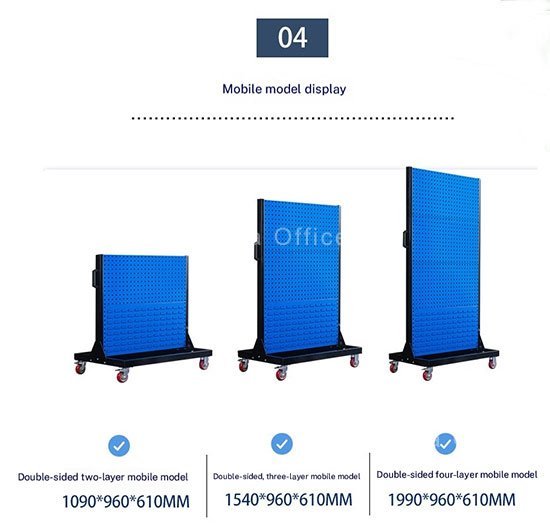
Three sizes, same footprint
All three versions share the same 960 × 610 mm plan, so they line up along a line and can be moved as a set. Only the length changes.
| Model | Size (L × W × H) | Working faces | Typical use |
|---|---|---|---|
| HNRK16ud | 1090 × 960 × 610 mm | 2 layers per side, 4 faces | One cell, one assembly station |
| HNRK16ud-3L | 1540 × 960 × 610 mm | 3 layers per side, 6 faces | A full line-side position, both sides stocked |
| Four-layer version | 1990 × 960 × 610 mm | 4 layers per side, 8 faces | High-part-count cells, multi-operator lines |
The two-tier HNRK16ud is rated at 150 kg per side, which is the figure to work from when you are loading heavy bins or full cartons rather than small parts.
Common build across the range:
- High-strength cold-rolled steel body with an electrostatic powder coating
- Standard blue, with black, grey and orange available
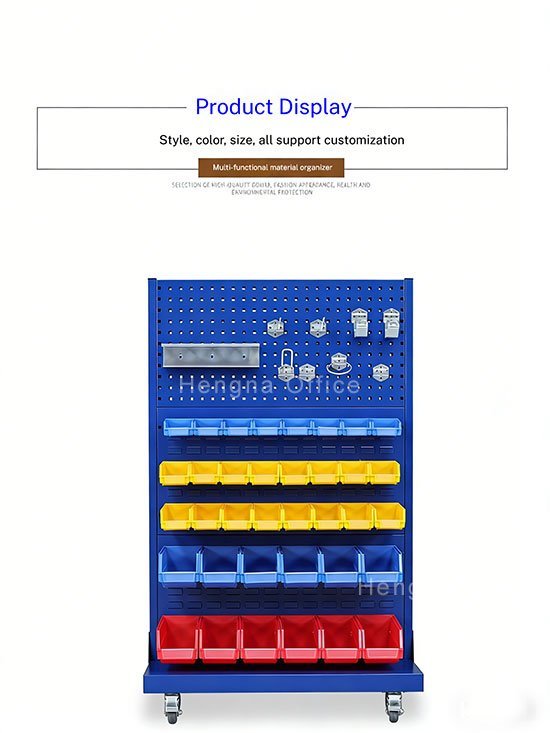
- Square-hole panel up top for hooks, slatted panel below for bins
- Metal hooks, plastic storage boxes in mixed sizes, and a U-shaped handle
- Four 3-inch universal casters, two of them braked
- Anti-slip foot pads supplied
Colour coding is what makes the signal readable
The bins supplied with these racks come in mixed colours, and the colours are not decoration. They are how a line tells part families apart at a glance and from a distance.
A workable convention is one colour per part family, held consistent across every rack on the line. Yellow for fasteners. Blue for brackets. Red for consumables that get consumed. Once the operator learns it, they do not need to read a label to know whether the bin they are looking at is the bin they want.
That convention only pays off if it is the same everywhere. If one rack is red for sensors and the next is red for washers, the colour stops carrying information and becomes paint.
Casters and brakes, in practice
Four 3-inch universal casters are standard, and two of them braked. On a smooth floor that is enough to move a loaded rack with one hand and lock it in place with a foot. The casters are universal rather than fixed, so the rack can be turned into an aisle rather than only pushed along it, and the U-shaped handle gives you something to push with when it is full — pushing a 1540 mm rack by its shelf edge is how you bend the frame.
Where these racks get used
Assembly lines and workstations. Electronics and appliance assembly, where screws, connectors and test accessories are consumed in small quantities all day.
Machining and mechanical workshops. Cutting tools, measuring instruments and small components at the machine cell.
Automotive service and 4S workshops. Hand tools on the upper panel, parts bins below, and the rack rolled to the bay rather than walked to.
Logistics, sorting and training rooms. Used as a transfer position between stores and the line, or laid out with tools displayed for a class.
Most of these sites are running 5S or lean practice, and this is one of the pieces that supports it: a fixed position, a defined part, a defined quantity, and a signal when it runs out.
Ordering and export
These racks ship pre-assembled. They arrive ready to use out of the box, with no assembly on site, which matters more than it sounds when the rack is being installed during a shutdown weekend or handed over to a new line.
For buyers fitting out several lines or sites, the same 960 mm plan across the range means a standard layout works everywhere. Send us the number of positions, and we will confirm the model mix, the colour and the packing plan with the quotation.
Custom work is routine: colour matched to your standard, hooks and bin sizes to suit your parts, and documentation in your own language. If you need a specific length or an extra tier, tell us the cell dimensions and we will work from those.
FAQ
What is the difference between the three sizes? Length only. 1090 mm is two layers per side, 1540 mm is three, and 1990 mm is four. Depth and height stay at 960 × 610 mm.
How much does it hold? The two-tier HNRK16ud is rated at 150 kg per side. Larger sizes are built for part bins and hand tools rather than heavy loads, so tell us what you are storing and we will confirm.
Are the bins included? Metal hooks and a set of plastic storage boxes are supplied as standard; bin sizes and quantities can be adjusted to suit the parts. Anti-slip foot pads are included.
Can I lock it? Bins and hooks are open access by design, because a locked line-side position defeats the purpose. Secure the area or the cell instead.
Does it need assembly? No. It ships pre-assembled and is ready to use on arrival.
What is the MOQ? Depends on the model, size and colour, confirmed with your quotation.
How do you quote — FOB or CIF? Either. Send the destination port and we will quote whichever suits your forwarder arrangements.
Warranty? One year.
After-sales? If something arrives damaged or a part is missing, send photographs of the crate and the item and we will arrange the replacement. Photograph the crate before opening it.
OEM and ODM? Yes. Custom colour, custom hook and bin configuration, custom sizing, and documentation in your own language.
Lead time? Confirmed with your quotation, depending on the model mix and the finish.
If you are setting up a line-side position, send us the part families and the number of bins you need on each side. We will come back with the model, the bin plan and a quote within 24 hours.