Last year a hotel group’s corporate office called us. Three of their properties had the same problem — cabinet bottoms rusted through, black mold growing in tile grout, and maintenance crews patching things up every few months. They had a budget approved but no one was sure what fix would actually stick.
After an hour on the phone, the facilities manager asked: “So we swap everything to stainless steel, and that solves it, right?”
I said: “Skip the drainage tray and stainless won’t help either.”
How to Stop Rust and Mold in Your Janitor Closet? Rust and mold — the real source is standing water
The problem in a janitor closet isn’t the cabinet material. It’s that nobody designed for water.
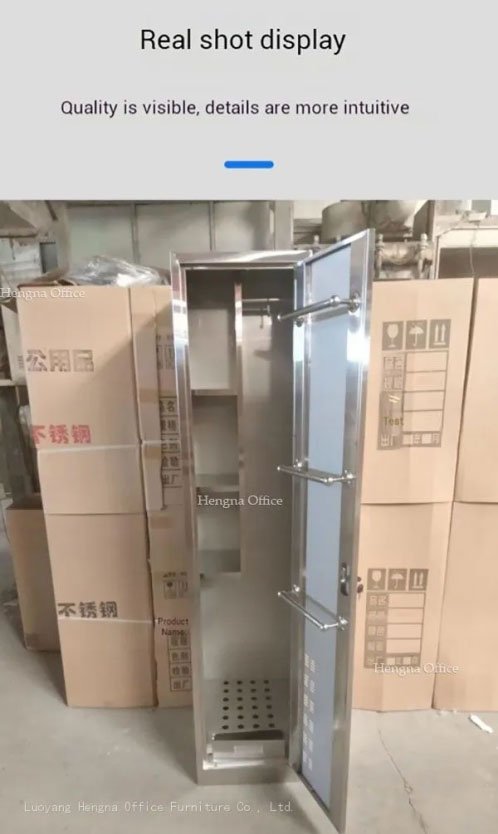
Mops dry standing up — water runs down the handle and pools on the floor. Buckets sit inside the cabinet with loose lids, seeping slowly. Wet rags get hung on the door overnight. None of that water evaporates fast in a small, unventilated room. It collects under the cabinet base, seeps into corners, and turns the whole closet into a mold farm.
Most janitor cabinets have a flat bottom. Water sits there. The cabinet’s contact surface stays wet. That’s what causes rust, and it’s what feeds mold.
Material matters less than you think. Type 304 stainless will survive years submerged — but even if the cabinet doesn’t rust, the closet still smells like damp. Mold doesn’t care what grade of steel your cabinet is made from. It cares about moisture. And the moisture comes from water that has no way out.
The counterintuitive truth: A cabinet’s first line of defense isn’t the material. It’s whether the cabinet can drain water out.
Powder-coated, stainless, and drainage trays — how they work together
Here’s what we’ve seen across dozens of hotel and hospital projects.
Powder-coated cabinet + flat bottom — rust within two years in humid climates, three to four in dry ones. The worst part isn’t the rust itself. It’s discovering it only after mold has already spread inside the cabinet.
Powder-coated cabinet + drainage tray — four years stable, six or more with basic maintenance. The tray lifts the cabinet base above the floor and channels water to a drain. The cabinet body never sits in moisture. The lifespan doubles, mostly because water gets diverted before it reaches the steel.
Stainless steel cabinet + flat bottom — won’t rust, but will still grow mold. The cabinet body stays intact. The closet still smells. Mold finds the moisture, not the metal.
Stainless steel cabinet + drainage tray — this is the real answer. Stainless handles the corrosion side. The drainage tray keeps things dry. Each handles its own job. Together they give you a closet that genuinely stays clean.
One thing buyers miss all the time: drainage trays are not standard. Many manufacturers sell them separately. Some don’t offer them at all unless you specifically ask. When you request a quote, ask directly: “Does this cabinet come with a drainage tray, and what angle/slope does the tray have?”
Three things more important than material when buying a drainage cabinet
The tray needs real slope — and deep channels.
A drainage tray isn’t just a flat sheet of metal with a hole punched in it. Water needs to flow, not pool. Look for at least 3 to 5 degrees of slope. Channels should be deep enough that mop lint and debris won’t clog them in a week.
The tray and cabinet should be separate.
A one-piece welded base looks cleaner on paper. But if the drainage channel rusts or gets damaged, you’re replacing the whole cabinet. A detachable tray — if it breaks, you swap the tray, not the entire unit. Modular is practical. If it fails, you replace one part and move on. Hotel maintenance people get this immediately.
Check the drain port location before you buy.
Some trays drain downward — you need a floor drain underneath. Some route through the wall. Others have a side port for a hose connection. Take a photo of the janitor closet floor before you call a supplier. Send it to us and we’ll tell you which configuration fits.
Other questions we hear
Do I still need ventilation if I have a drainage tray?
Yes. The tray handles water that hits the floor. But humidity in the air stays there. Cabinets with louvered doors plus a drainage tray — those two together give you a complete solution. A tray alone still leaves trapped moisture inside the cabinet.
Can I add a drainage tray to existing cabinets?
Sometimes. If the cabinet has a flat bottom and enough clearance underneath, you can retrofit one. But a retrofitted tray never feels as solid as one built for the cabinet from the start. If you’re buying new, get the tray included.
Do drainage trays need cleaning?
Yes. Sediment from mop buckets, bits of scrub pad, general grime — it builds up in the channels over time. That’s where the detachable tray earns its keep. Pull it out, rinse it with a hose, put it back. Stainless trays handle scrubbing with a wire brush just fine.
One thing buyers miss all the time: drainage trays are not standard equipment. Many manufacturers list them as an optional add-on. Some don’t offer them at all unless you ask specifically. When you request a quote, ask directly: “Does this cabinet include a drainage tray, and what slope does the tray have?” The slope needs to be at least 3-5 degrees. A flat tray with a hole isn’t a drainage tray — it’s a flat tray with a hole. Water needs somewhere to go. For a comparison of how different materials handle wet environments, see our powder-coated vs stainless janitor cabinet breakdown.
If you’re already running a hotel or hospital janitor room with existing cabinets that don’t have drainage trays, you have three options. One: retrofit a tray if the cabinet has clearance underneath — it’s cheaper than replacing everything but the fit won’t be perfect. Two: add a dehumidifier to the room and accept that you’ll replace cabinets sooner. Three: phase in new cabinets with integrated drainage trays over two budget cycles, starting with the rooms that get the wettest — the ones closest to the pool, the basement level, or the tropical-facing side of the building. The same principle applies to 304 stainless hospital cleaning cabinets — start with the highest-risk rooms first.
What you should actually check when buying
Go through this list in order and you won’t pick the wrong cabinet:
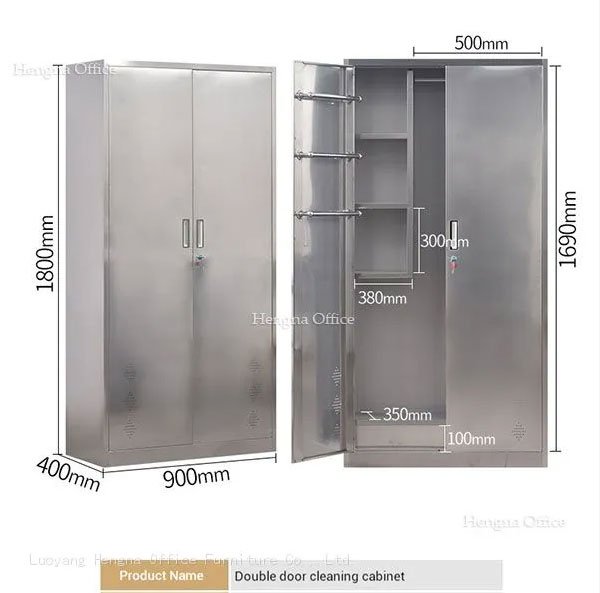
First — does it have a drainage tray? What’s the slope? Is the tray detachable?
Second — does the door have ventilation louvers? Is there enough airflow through the cabinet?
Third — what does the closet floor look like? Is there a floor drain? Wall access? No point buying a downward-drain tray for a room without a floor drain.
Fourth — now decide the material. 201 for dry inland climates. 304 for coastal, tropical, or luxury brand standards. Powder-coated if the closet is dry and the budget is tight.
Fifth — internal accessories. How many shelves? Hooks for mops? Clips for brooms? Can you customize the interior layout?
The first question on that list — not the fourth — is the one that matters most. Get the water out first. Everything else comes after.
Luoyang Hengna Office Furniture Co., Ltd. — 9 years in the industry, CE certified, own trademark, directly partnered with production facilities, manufacturer-direct supply. Drainage trays included as standard, not an upsell. Quotes within 24 hours.