A workbench does not fail all at once. It fails in two places, and both of them are slow enough that nobody reports them.
The first is the drawers. They start running heavy, then they start sagging at the front, then the slide binds when the drawer is half out and the technician levers it instead of pulling it. The second is the frame and top. The top dishes under a vice, the frame twists at the leg where it meets the floor, and the whole bench develops a lean that nobody can point at but everybody can feel.
Both of those are design decisions, not accidents. They are decided by the slide and by how the frame is built, and you can specify both.
The drawer problem is a slide problem
A drawer that sags is almost always a slide problem. Friction slides are sized for a box of screws, not for a set of torque wrenches. Under a real load they deflect at the extension, which puts the front of the drawer lower than the back, which is exactly what a person feels as sag.
The slides specified for this bench are three-section ball bearing, full extension. Three sections mean the drawer carries its load on the middle section while it is extended, rather than cantilevering it off the front rail. Ball bearings mean the drawer rolls rather than scrapes, even fully loaded, which matters on a bench where somebody pulls a drawer with one hand while holding a part in the other.
Full extension is only half of it. The slides also carry an anti-tip stop, so a drawer pulled all the way out stays level and does not drop when the technician lets go to reach for something else. On a bench where each technician owns their own tools, that is the difference between a drawer that stays usable for years and one that gets levered and bent.
The frame problem is a forming problem
The second failure starts at the leg. Many workbenches are built from steel tube, spot-welded together. A spot weld is a point contact, and a point contact is where a frame twists when you put a load on one corner and stand on the other.
The frame here is formed cold-rolled steel, not tube stock welded at the joints. Formed sections hold their shape along their length, so the leg does not bow and the top does not dish when the load moves to one side. This is also why the bench can be bolted to the floor and stay bolted, instead of walking across the shop every few months.
The top is a choice, and six thicknesses
Steel plate tops are available in six thicknesses: 2, 3, 4, 6, 8 and 10 mm. The right one is not a quality tier, it is a job match.
| Top thickness | What it is for |
|---|---|
| 2 mm / 3 mm | Electronics assembly, small-parts sorting, QC packing, line-side inspection. Light handling, light shipping cost. |
| 4 mm | General assembly, training workshops, equipment commissioning. Takes occasional pressure without moving up a tier. |
| 6 mm | Auto repair and mechanical work involving hammers, bearing presses and larger components. The usual starting point for repair work. |
| 8 mm / 10 mm | CNC machining, mould maintenance, forging lines. These two are separately reinforced, not simply a thicker sheet on the same frame. |
6 mm is the point most buyers stop at, and it is worth knowing what it actually carries. A 6 mm plate holds its shape under an engine block and stand together, roughly 700 to 800 kg, without permanent deformation. We check this rather than assume it: test weights are applied at the production facility and the deflection is measured, because “heavy duty” is not a number anyone can check from the outside.
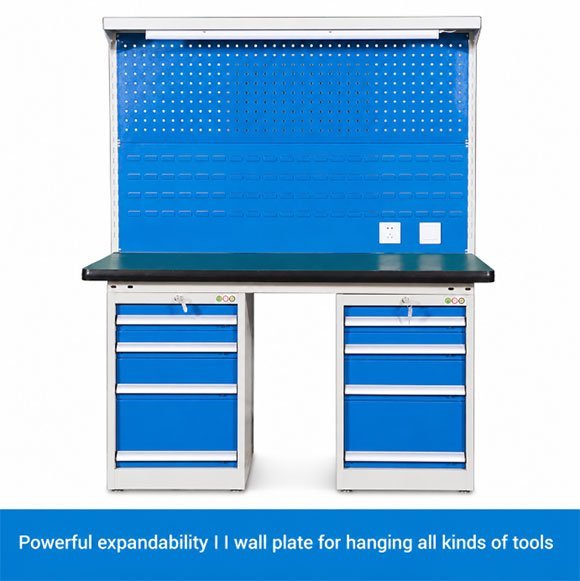
Configurations and sizes
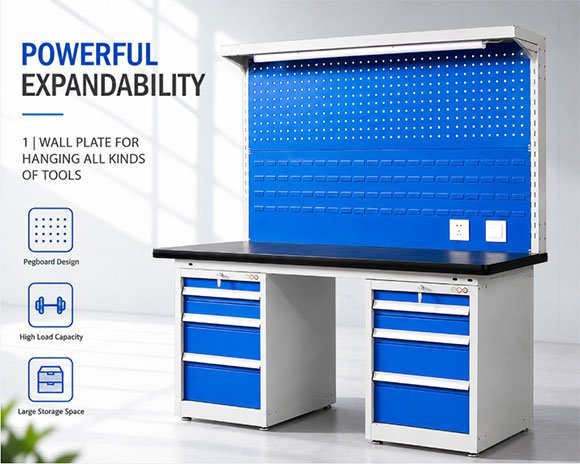
The bench is built as a platform rather than a fixed table, so drawers, pegboards, light stands and power sockets can be added or moved as the station changes. Six configurations and three top materials are offered as starting points rather than as a fixed catalogue.
| Item | Specification |
|---|---|
| Frame | Formed cold-rolled steel, electrostatic coating |
| Drawer slides | Heavy-duty three-section ball bearing, full extension, with anti-tip stop |
| Drawer layouts | 4, 5 or 6 drawers; single cabinet or one cabinet each side |
| Locking | One-key central lock, or a separate lock and key per drawer cabinet |
| Top options | ESD composite, stainless steel, beech wood, or steel plate in six thicknesses |
| Standard depth | 750 mm, adjustable |
| Standard widths | 1200 / 1500 / 1800 / 2100 / 2400 mm |
| Back panel | Square-hole pegboard, add-on or fitted |
If your shop does electronics work, tell us and the top comes with ESD matting rather than bare plate. If the bench is going into a repair bay rather than an assembly line, the two-cabinet layout is the one that works, because the technician can keep their own tools and their own key.
Packing and delivery
Benches ship flat-packed. The pegboard travels as a separate component inside a reinforced carton, steel parts are separated with moisture barrier film and edge guards, the slide mechanisms are foam-wrapped so they cannot rattle against the frame in transit, and the cartons sit on a wooden pallet for container loading. Flat packing is what keeps the freight cost down on a piece of furniture this size, and the frame is a single welded assembly so there is very little to bolt together on site.
For buyers fitting out a whole line, consolidation is usually the cheapest route: a mixed load of benches, drawer cabinets and racks shares one container rather than going separately. Send us the workstation count and the widths you need, and we will lay out the load with the quotation.
FAQ
What does “ball bearing” actually mean for the drawer? The rollers are ball bearings rather than nylon or steel rollers running in a channel. They keep rolling under load with no lubrication schedule, and they are what allows full extension without the drawer binding halfway out.
Will the top sag under a heavy load? At 6 mm it holds an engine block and stand, roughly 700 to 800 kg, without permanent deformation. We measure deflection under test weights at the production facility rather than quoting a figure we have not checked. Heavier work needs 8 or 10 mm, which are separately reinforced.
Can I add drawers later? Yes. The bench is a platform, and drawers, pegboards, light stands and power sockets bolt on. If the station changes next year, the bench stays and the accessories move.
How many drawers do I need? Four, five or six, in a single cabinet or one cabinet each side. One cabinet each side suits a bench where two people work the same station, because each keeps their own set and their own key.
Do you supply pegboards and lighting? Pegboards are optional and the lighting and power options are add-ons, specified before production so the mounting points are in the panel from the start.
What is the MOQ? Depends on the configuration and the top, confirmed with your quotation.
How do you quote — FOB or CIF? Either. Send the destination port and we will quote whichever suits your forwarder arrangements.
Warranty? One year on the frame and worktop under normal use. After that we still supply replacement slides, lock cores and other wear parts, so a bench bought now can be kept going rather than replaced.
After-sales? If something arrives damaged, send photographs of the pallet and the cartons and we will arrange the replacement part. Photograph the pallet before unpacking, since damage claims are assessed against those pictures.
OEM and ODM? Yes. Your logo, colour matched to your standard, pegboard layout, drawer count, lock type and light stands are all adjustable.
Lead time? Confirmed with your quotation, depending on the configuration and the finish.
If you are replacing benches on a line, send us the top you use now and the load you actually put on them. We will tell you which thickness fits and what changes between the six.