Short answer: three drawers and a pegboard is the right setup for a bench that does both assembly and repair. Below are the questions buyers actually send us before ordering this bench, answered in the order they usually come up. No feature list — just the answers, with the numbers behind them.
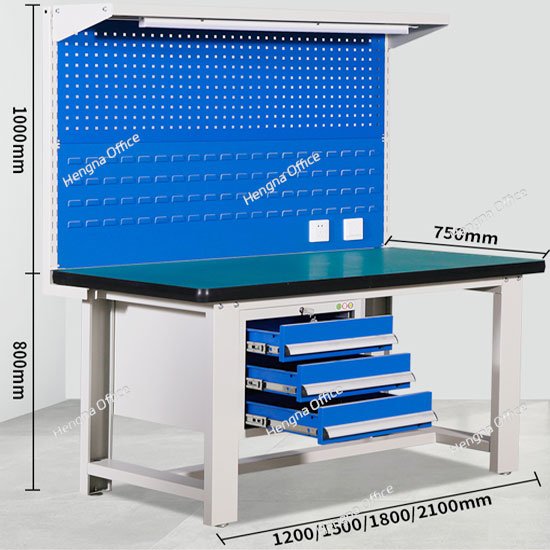
Are three drawers enough, or should I take five?
Three is enough when the drawers are for the tools you use at the bench, not for general storage. A bench drawer holds what the job in front of you needs: measuring tools, fasteners, a driver set, the wrench you keep reaching for. General storage belongs in a cabinet, not under the bench.
If you find yourself wanting a fourth and fifth drawer, the usual cause is that the bench is doubling as the shop’s store room. In that case a panelled cabinet beside the bench works better than a deeper drawer stack, because it separates “tools for this job” from “everything else.”
One number to keep in mind: a drawer that is too deep becomes a box. Two shallow drawers at 100 mm and one deeper at 200 mm beats three identical 200 mm drawers for most bench work.
Is the pegboard actually useful, or just decoration?
Useful — if you hang the things that must be seen. Screwdrivers, pliers, hammers and calipers belong on the board because you want them in sight and in reach. Things that belong in a drawer are the ones you use less often or that must stay clean.
The mistake most shops make is hanging too much. A board loaded edge to edge is harder to scan than a board with eight or ten tools in fixed positions. Hang what you use every hour, leave the rest in the drawers, and the board stays a tool, not a wall of clutter.
Pegboard also solves the bench-top problem. Every tool on the board is one less tool on the surface, and surface is the scarcest thing on a workbench.
How much load does the top take?
Enough for assembly work with real components — a motor, a gearbox, a pump — not just a laptop and a coffee cup. The frame is reinforced steel, and the top is specified for the working load of the bench rather than for a catalogue photo.
Two practical checks before you load it. First, put the heaviest item over a leg, not in the middle of the span. Second, do not use the drawers as a step or a seat — a drawer that holds 50 kg of tools is not a ladder.
1200, 1500, 1800 or 2100 mm — which length?
Measure the wall, then subtract the space you need to walk past. A bench that fills the wall but blocks the aisle gets pushed out of position and never comes back.
- 1200 mm — one person, one task, tight shop. Good for electronics and small assembly.
- 1500 mm — the common choice. Room for a part on one side and tools on the other.
- 1800 mm — two people working side by side, or one person with a large assembly.
- 2100 mm — heavy assembly or a bench that doubles as a packing station.
If you are between two sizes, take the smaller one and add a side shelf. A bench with space around it gets used; a bench wedged into a wall does not.
Will the legs wobble under load?
Not if the frame is braced and the bench is assembled square. Wobble almost always comes from three things: an unbraced frame, feet that are not levelled, or a bench assembled on an uneven floor without adjusting the feet.
Ask for levelling feet. On a concrete floor with a slope — most shop floors have one — levelling feet are the difference between a solid bench and a bench you shim with cardboard.
How long does assembly take?
Two people, hand tools, roughly the time it takes to drink a coffee and a half. The bench ships knocked down with labelled parts and an instruction sheet. The one step people get wrong is tightening the frame before it is square — snug the bolts, check the diagonals, then tighten.
Can I choose the top material?
Yes. A steel top suits welding, heavy assembly and anything that gets knocked about. A stainless top suits clean work, food-adjacent packing and wash-down areas. A static-dissipative top suits electronics assembly, where a stray charge does more damage than a dropped spanner.
The top matters more than the frame for how the bench feels in daily use. Ask what the top is rated for before you compare prices — two benches at the same price can have very different tops.
Do the drawers lock?
Yes, a central lock is available. On a shared bench, a lock is less about theft and more about keeping a calibrated tool where it belongs. If several people use the bench, ask about keyed-alike options so one key opens the bench drawers and the cabinet beside it.
Can I fit a light or a power strip?
Yes. The pegboard uprights take a light bracket, and most frames have room to mount a power strip under the top or on the back panel. Tell us at the time of order if you want the mounting points prepared, because retrofitting them later is fiddlier than adding them at build.
Does it need clearance behind?
A bench with a pegboard wants to sit against a wall — the board is the point. But leave enough gap to reach behind for cables, and enough room at each end to walk around. A bench boxed into a corner on three sides is a bench you stop using.
How long does the finish last?
Powder coating on a properly prepared frame holds its colour for years in a normal workshop. What shortens it is chemistry and contact: brake fluid left overnight, coolant splashed and not wiped, or a heavy vice bolted on without a pad. Wipe spills the same day, put a plate under a vice, and the finish outlasts the bench’s first owner.
Bench sizes
| Item | Detail |
|---|---|
| Lengths | 1200 / 1500 / 1800 / 2100 mm |
| Drawers | 3, mixed depth |
| Back panel | Pegboard, full width |
| Frame | Reinforced cold-rolled steel, powder coated |
| Feet | Levelling feet |
| Assembly | Knocked down, labelled parts |
Still have questions
If your question is not here, send it. The ones that come up most are about drawer layout, whether a shelf can be added under the bench, and whether the pegboard can be replaced with a plain back panel. All three are answerable before you order.
FAQ
What is the minimum order quantity?
MOQ depends on length and drawer layout. Tell us the quantity and we will confirm.
How do I get a quote?
Send the length, drawer layout and destination port. We reply within 24 hours.
Can I add an under-bench shelf?
Yes, on most frame configurations. Tell us at the time of order so the frame is prepared for it.
Can the pegboard be replaced with a plain panel?
Yes. A plain back panel is available if you prefer a clean wall for shelves or light brackets.
Do you offer OEM and ODM?
Yes. Silk-screen logo, custom carton printing and a custom manual are available.
What is the lead time?
Lead time depends on length, layout and quantity. We confirm the schedule when the order is placed.
How is the bench packed?
Knocked down, frame in moisture film, top and panels protected with card and corner guards, hardware bagged and labelled.
Can I get a different colour?
Yes, on larger orders. Send the RAL or Pantone reference.
Send us the length, layout and port — we will come back with a quote within 24 hours.