Before You Buy a Workbench
If you’re outfitting a production line with a dozen workstations, you’re not buying a table. You’re buying where your people will spend eight hours a day for the next five-plus years. The bench has to fit the work. Not the other way around.
Most off-the-shelf workbenches give you exactly one layout. You buy it, you bolt it down, and that’s it. Six months later your line expands, or the task at that station changes, and the bench you paid for is wrong. You can’t add drawers where there aren’t mounting points. You can’t move the pegboard to the other side. You shove it in a corner and buy another one.
That’s what a modular system fixes. The bench is a platform. Drawers, pegboards, light stands, power sockets — you add what you need. If the workstation changes next year, the bench stays. The accessories move.
Wood Workbench vs Folding Table vs Modular Steel — What Actually Happens
A wood workbench looks fine on day one. A month in, the top has dents from a vise clamp and oil stains that soaked through. In a humid shop, the boards swell and the frame loosens. That bench isn’t dying — it’s just becoming unusable for precision work.
A folding table says “200 kg capacity” on the sticker. That number is for evenly spread weight, sitting still. Put a transmission housing on one corner and the whole table tips. The legs flex. Nobody trusts it for anything over a brake rotor.
A modular steel workbench solves these by design:
- The steel top doesn’t soak, dent, or swell
- The frame is formed cold-rolled steel, not tube stock spot-welded together
- If you need more storage later, you bolt it on
If your shop does real work every day, buy something that was built for it.
Modular Workbench System – 6 Configurations — Pick the One That Matches Your Station
These aren’t six SKUs you choose from a dropdown. They’re six starting points. Width, top material, drawer count, and color all change based on what your station actually does.
Single Table + Double 4-Drawer Cabinets
One work surface. One four-drawer cabinet on each side. Each drawer has independent locks and anti-tip slides — pull it all the way out, it won’t drop.
A motorcycle repair chain we worked with in Vietnam runs this layout. One tech per station. Left drawers hold socket sets and torque wrenches. Right drawers hold gaskets, seals, spark plugs — the stuff you grab constantly. No pegboard, because in their climate uncovered tools collect dust overnight.
If your station has one person doing focused work with a manageable tool set, this is where you start.
Double 4-Drawer + Double Pegboards
This layout separates your tools into two zones: what you grab blind and what you need to see.
Square-hole pegboards on both sides hold the daily-use tools — combination wrenches, pliers, screwdrivers, hammers. You reach without looking. The louvered panel below takes parts bins — screws, washers, terminals, wire connectors sorted by size. When a bin runs low, you see it before it’s empty.
The four-drawer cabinets underneath handle deep storage — backup stock, specialty tools, personal gear. This is the layout for an auto repair bay, a farm equipment maintenance shop, or any station where tools change by the job.
Single Table + 1 Drawer Cabinet + Double Pegboards
Some workstations aren’t about tools at all. They’re about equipment.
An oscilloscope sits on the left. A benchtop power supply on the right. The operator watches readings for most of the shift and occasionally reaches for a probe or a screwdriver. What that person needs isn’t four drawers of sockets — it’s a clear surface, a power socket within arm’s reach, and test leads hung where they don’t tangle.
One drawer handles consumables and the few hand tools this station uses. The pegboards carry test leads, probe holders, and ESD-safe tweezers. This is an electronics QC bench, an incoming inspection station, a lab instrument table.
Single Table + 3 Drawer Cabinets + Double Pegboards
This is the station where one person does three different things in a day — assembly in the morning, debugging after lunch, inspection before clock-out.
Each task needs a different tool set. Three drawers mean three sets, separated. No digging through a mixed drawer for the one caliper that lives at the bottom. The pegboards handle the crossover tools that every task shares.
Line supervisor stations, prototype build benches, R&D lab tables.
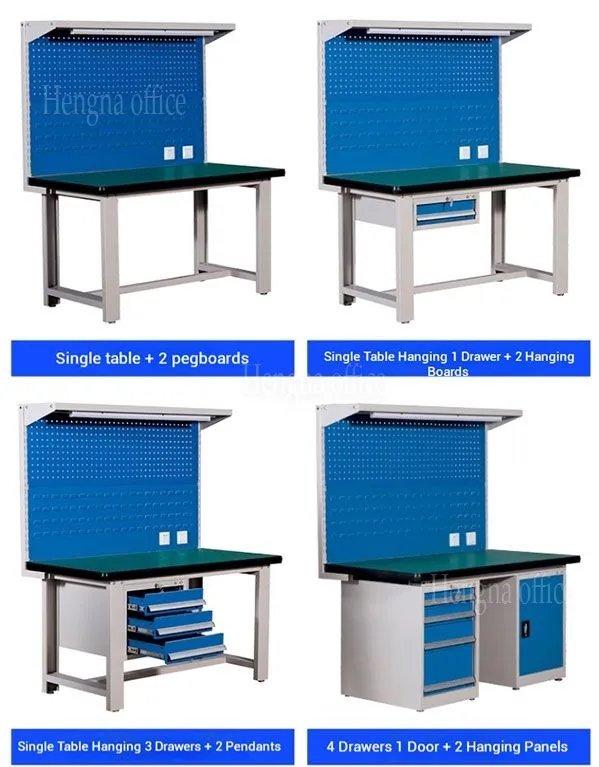
4 Drawers + 1 Door Cabinet + Double Pegboards
The door cabinet is the difference here.
Drawers are open-top. You see what’s inside. A door cabinet closes completely. Nothing visible. For shops that go through ISO audits or host customer walkthroughs, this matters. Expensive measuring instruments, calibration records, personal items — behind a closed door, the station looks clean and audit-ready.
The four drawers handle standard tool storage. The pegboards stay. This layout is common in precision machining shops, medical device assembly, and any facility where shop-floor appearance affects business.
Single Table + Double 4-Drawer + Double Pegboards
Full build. Two four-drawer cabinets, two pegboards, optional LED light stand and wall-mount power socket.
This is for the person whose station is the backbone of the line — the lead tech, the senior machinist, the guy who doesn’t have time to walk across the shop for a tool. Everything lives at this station. Lock it all up at the end of shift and nothing walks away.
Three Top Materials. Three Different Industries.
The top isn’t an aesthetic choice. It determines whether your bench belongs in an engine shop or a pharmaceutical cleanroom.
Anti-Static Laminate Top — Electronics and ESD-Sensitive Assembly
Green ESD-safe laminate over high-pressure fiberboard, PVC edge banding. The surface has a slight give — not hard like steel, not soft like rubber. That give matters when you’re placing a PCB or a bare IC on the surface. No scratches. No edge damage.
A ground wire connects the top to earth, and static charges bleed off instead of discharging through your components. One ESD event can kill a chip before it leaves the assembly station. You won’t know it’s dead until final test. This top prevents that.
For PCB assembly lines, semiconductor packaging, EV battery module assembly, electronics repair stations, and lab instrument benches.
Steel Plate Top — Mechanical Work, Auto Repair, Fabrication
Steel plate bonded to a high-density fiberboard core. Available in six thicknesses: 2mm, 3mm, 4mm, 6mm, 8mm, and 10mm.
2mm handles light assembly. 4–6mm handles daily repair work — engine components, brake assemblies, hydraulic parts. 8–10mm handles heavy machining, welding prep, and jobs where you’re setting a full engine block on the surface.
Oil, cutting fluid, brake cleaner — wipe it off. The top doesn’t absorb anything. It doesn’t stain, swell, or warp. A wood top in the same shop would be black and spongy in three months.
For machine shops, auto repair garages, welding stations, metal fabrication shops, and heavy equipment maintenance.
Stainless Steel Top — Food, Pharma, and Hygiene-Required Environments
1mm stainless steel wrapped over high-density fiberboard. Available in grade 201 or 304.
Grade 201 handles general corrosion resistance. For anything involving food contact, pharmaceutical production, cosmetic manufacturing, or dairy processing — you need grade 304. This isn’t a preference question. It’s a compliance question. Food safety inspectors check the material grade. 304 is food-grade and pharmaceutical-grade. It withstands repeated cleaning with sanitizing chemicals and doesn’t pit from mild acids.
If your facility gets audited for hygiene standards, get the 304 top. If you’re in a general industrial setting that just happens to be damp or coastal, 201 will do the job.
For food processing plants, dairy facilities, pharma GMP cleanrooms, central kitchens, breweries, and cosmetic production lines.
Materials and Build Quality
The frame and cabinet body are SPCC cold-rolled steel. This is the same steel grade used for automotive body panels — it holds its shape under repeated stress. Formed from full sheets, not tube stock. The joints don’t loosen after a year of daily use.
Finish is electrostatic powder coating, not wet paint. Standard color is gray-white body with blue drawer fronts. If your shop has a color scheme or you need a specific look for branding, tell us early — the color gets locked in before powder coating.
Drawer slides are heavy-duty with an anti-tip stop at full extension. Each drawer cabinet gets its own lock and key. In shops where technicians own their tools, this matters — your drawer, your key, your responsibility.
We hold CE certification. If you need additional certs for your market, we’ll confirm feasibility and timeline with your quotation.
Dimensions and Shipping
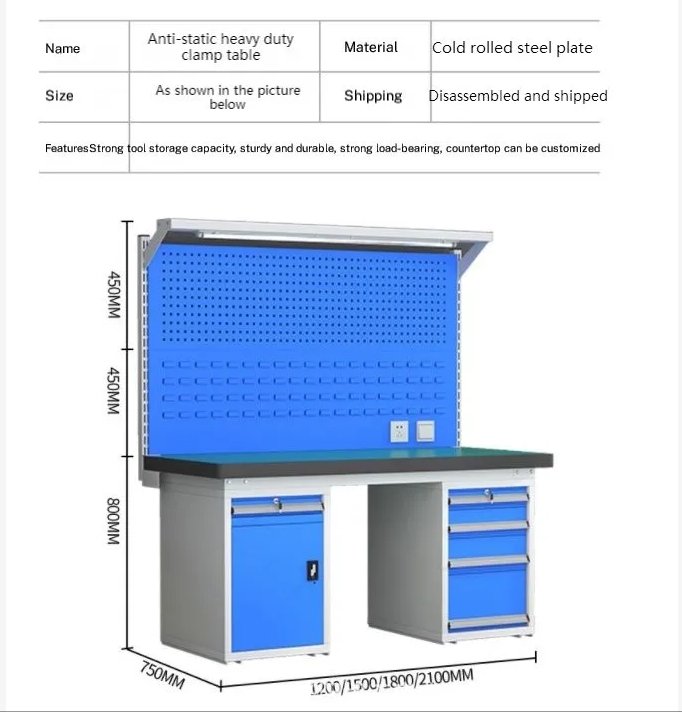
The working surface sits at 800mm height and 750mm depth. Width comes in four options: 1200mm, 1500mm, 1800mm, or 2100mm.
Table height is fixed at 800mm — this is the standard ergonomic working height for both seated and standing use across most of the global market. If your floor isn’t perfectly level, each leg has an adjustable foot for fine-tuning.
With the light stand installed, total height is 1950mm. Without it, 1700mm. The light stand fits standard LED tube fixtures. Power sockets mount on the wall-facing panel.
The entire bench ships KD — knocked down, flat-packed. The top, frame, drawers, and pegboards pack as separate components inside reinforced cartons. Steel parts are separated with moisture barrier film and corner protectors. Slide mechanisms are wrapped in foam. The cartons sit on a wooden pallet for container loading.
KD packing cuts your freight cost significantly. A bench that takes up half a cubic meter assembled packs into a fraction of that volume flat. A 20-foot container can carry far more stations this way, and every dollar saved on freight is a dollar off your landed cost.
Each shipment includes a printed English assembly manual with step-by-step diagrams. No welding, no specialty tools required. Most customers have a station fully assembled in under thirty minutes.
FAQ
What’s the MOQ?
One unit gets it done. Container mix-loads get better per-unit pricing. Send us what you need — quantities, configurations, destination port — and we’ll work the numbers for you.
Can I mix drawer types, cabinets, and pegboards?
Yes. Drawer cabinets, door cabinets, pegboards, light stands, power sockets — these are all modular bolt-on components. There is no “standard configuration” — you tell us what the station needs, and the production line builds it that way.
How do I choose the right steel plate thickness?
2mm for light assembly and general use. 4–6mm for auto repair and standard machine shop work. 8–10mm for heavy machining, engine work, and welding stations. Not sure? Tell us what kinds of parts and equipment will sit on the surface. We’ll recommend the right thickness.
201 or 304 stainless — which one?
If your facility handles food, pharmaceuticals, dairy, or cosmetics — 304. No exceptions. It meets food-grade and pharma-grade hygiene standards. For general shop use where corrosion resistance is nice but not regulated, 201 works and costs less.
How does the packaging hold up for ocean freight?
We’ve shipped steel furniture in KD format for nine years. Zero quality claims from packaging failure in that time. Steel components are separated with moisture barrier film and edge guards. Slides are foam-wrapped. Cartons are strapped to a wooden pallet. If anything arrives damaged — it almost never does, but if it does — you take photos, we ship replacement parts, we cover the freight.
Do you offer OEM and custom branding?
Yes. Silkscreen your logo on drawer fronts or the cabinet body. We build to your dimensions and configuration. Packaging can carry your branding or stay neutral. Tell us what you need and we’ll confirm feasibility and any minimums with your quotation.
How hard is assembly?
Every order ships with a printed English assembly manual — step-by-step diagrams, not just a parts list. KD design means the bench was engineered for assembly, not retrofitted into flat-pack later. No welder, no specialty tools. If you hit a snag on site, send us a photo or a short video. We’ll walk you through it the same day.
What’s the warranty and after-sales support?
One-year warranty on the frame and worktop under normal use. After the warranty period, we still carry replacement slides, lock cores, and other wear parts — contact us anytime and we’ll get them to you. You’re not buying one order from us. You’re buying a supply relationship. After-sales emails get a same-day response.
What about load capacity? Do you have test data?
Load capacity depends on your top material and thickness combination. Every configuration variant goes through pressure testing at our production facility — we apply calibrated test weights and measure deflection. If you’re putting an engine block with transmission on the bench — roughly 700–800 kg with the engine stand included — a 6mm steel plate top handles that without permanent deformation.
The exact test report for your configuration comes with your quotation. Tell us what you’re working with, and we’ll match the data to your needs.
How fast do I get a quote? FOB or CIF?
Within 24 hours. Both FOB and CIF are available. Give us your destination port and we’ll calculate landed cost. Not a canned estimate — we work the actual freight numbers.
How do I get in touch?
Use the inquiry form on this site, or email us directly. Quote within 24 hours. Email response same day. This isn’t marketing language — it’s our internal SOP, and we’ve run it this way for nine years.