The first question most buyers ask us is simple: “How thick should the steel top be?” Our answer is straight:
Steel plate tops come in six thicknesses — 2, 3, 4, 6, 8, and 10mm. Light jobs like electronics assembly and parts sorting are fine with 2-3mm. Auto repair and mechanical work that involves hammering and pressing start at 6mm. Heavy CNC machining and forging shops need 8-10mm. If you pick wrong, you don’t scrap the whole bench — you pay a bit more and step up one thickness. The base cabinet, pegboard, and drawers all stay.
Below we walk through all six, so you can decide on your own.
What Steel Thickness for Workbench Top?Six Thicknesses and What Each One Is For
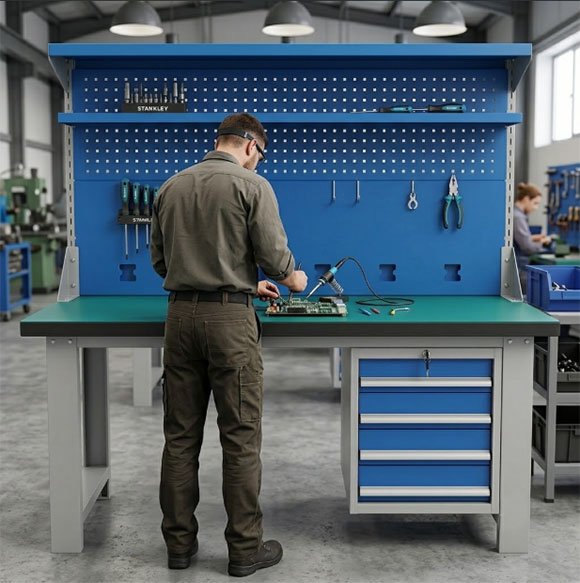
2mm / 3mm — Light assembly range Benches for PCB soldering, small-parts sorting, and QC packing hold light items and see gentle handling. These two are the cheapest, lightest, and cheapest to ship — common choices for line-side inspection stations and service benches.
4mm — General-purpose range Takes occasional heavy pressure better than the light range, without the cost of the heavy range. Most used for hardware assembly, training workshops, and equipment commissioning stations.
6mm — Auto repair and mechanical range Garage work, farm equipment repair, transmission teardown — these jobs involve hammers, bearing presses, and big components. A 6mm plate holds its shape under that load, which is why 6mm is the starting line for auto repair. We’ve supplied this exact spec to many repair shops across the Middle East and Southeast Asia.
8mm / 10mm — Heavy forging range CNC machining, mold maintenance, and forging lines put constant cutting force and impact on the top. These two are separately reinforced in our plant — not just “a thicker sheet stuck on.” They are built for years of abuse.
Why Six Options Instead of One Fixed Thickness
A lot of buyers assume a workbench comes in one standard thickness. It doesn’t.
Our steel plate tops use SPCC cold-rolled steel over a fiberboard base. The steel layer thickness is adjustable — you buy 2mm today, your workshop adds a machine next year, you pay to step up to 6mm, and the cabinet plus pegboard don’t move. That’s the whole point of six options: you’re buying a bench that evolves, not a welded slab.
For purchasing, that means two things. First, your first order can save money with a thin plate and step up later as the business grows. Second, you don’t switch suppliers just to get a thicker top — no new sampling, no new factory audit.
Three Mistakes Buyers Make on Thickness
Mistake 1: Thicker is always better? No. 10mm is stronger than 2mm, but also heavier, pricier, and costlier to freight. Putting 10mm in an electronics bay is wasted steel. Decide what sits on the top and how it’s handled before you pick.
Mistake 2: Thin plates collapse? Our 2-3mm tops are fiberboard base with steel facing — they don’t collapse under normal use. The only failure case is using a light-assembly top for heavy-forge work. Pick the range for the job; don’t grab the wrong bench.
Mistake 3: Thickness equals a load number? Worth clarifying: we rate load capacity per actual configuration, not one fixed number printed on every model. Width and reinforcement change the number. Tell us what you’ll place on the top — size and weight — and we return the matching config with real test data. A pretty number on a spec sheet beats nothing; real data beats a pretty number.
How the Steel Top Fits with the Other Two
The steel plate top is one of three surfaces we offer. The other two:
- Anti-static laminate top — green vinyl surface for electronics assembly and labs. (We say anti-static laminate, not Melamine top.)
- Stainless steel top — 1mm clad, 201 or 304 grade, for food processing and pharmaceutical GMP. (We say Rust Resistant, not Rust Proof.)
A real workshop usually mixes them: anti-static in the assembly area, 6mm steel in the repair bay, stainless in the packing area. The six steel thicknesses answer “how thick should the steel area be” — they don’t replace the other two.
Two Things Overseas Buyers Ask About
Freight. A steel plate top is lighter than a solid cast slab, and with our KD flat-pack shipping the sea volume runs about 40% under fully-assembled packing. That matters a lot on long hauls to the Middle East and Africa.
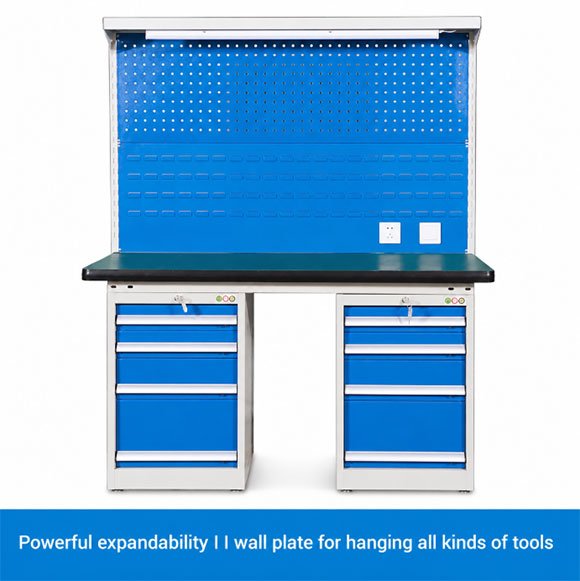
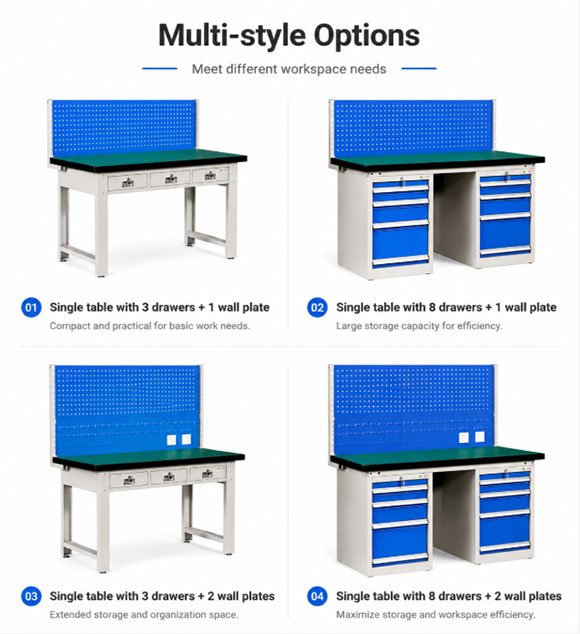
Modularity. Light stands, square-hole pegboard, louvre panels, power strips, drawer cabinets — all modular. Step the steel thickness up and the pegboard and drawers carry over. Nothing wasted.
Quick Recap
- Light work: 2-3mm. General: 4mm. Auto repair: 6mm. Heavy forge: 8-10mm.
- Six options — step thickness up, keep the base.
- Load rated per config, no fake numbers printed.
- Stainless tops are Rust Resistant, not Rust Proof. Anti-static tops are anti-static laminate, not Melamine.
Tell us your scenario, top size, and roughly what it needs to hold. We return a config and a quote within 24 hours.
FAQ
What is the MOQ for a custom steel top workbench? We handle both sample orders and full containers. MOQ depends on configuration; tell us the model and we confirm.
What are your FOB terms? We quote FOB normally and can discuss CIF/DDP per destination. Final terms are set in the proforma invoice.
What warranty do you provide? We cover manufacturing defects under our standard warranty. Spare parts are supplied separately so a single component is easy to replace.
What after-sales support do you offer? Our team responds to installation and part questions, and we keep common components in stock for repeat orders.
Do you support OEM / ODM? Yes. We do OEM with your logo and ODM on configuration — pegboard layout, drawer count, lock type, light stands, all adjustable.
What is your production lead time? Lead time varies with order size and customization. We give a confirmed date with the quotation, not a vague range.
How is the bench packaged for export? KD flat-pack in cartons on pallets, with corner protection. Sea volume is about 40% less than assembled, which cuts your freight.
Luoyang Hengna — 9 years building steel workshop furniture, CE certified, quote within 24 hours. Not a trading company; we run our own plant and powder-coating line.