The question we hear most at the booth is plain: “What’s the difference between 201 and 304, and which do I pick?” We don’t give a vague answer:
Both are stainless steel tops, but they differ in nickel content and corrosion resistance. Dry general workshops, tool rooms, and basic mechanical bays do fine on 201 — it saves money. But any food-contact surface, pharmaceutical GMP area, or chemical environment must run 304. Not for looks — for compliance and service life. 201 rusts in damp, salty conditions; 304 holds up. Picking wrong isn’t wasting a few dollars, it’s buying trouble later.
Here’s both sides, laid out.
The Material Itself
201 stainless steel
Lower nickel, with manganese standing in for part of it. Lower cost, bright surface, enough rigidity. The weak spot is corrosion resistance — fine in a dry shop, but give it moisture, salt spray, or acid-alkali and rust spots show up over time.
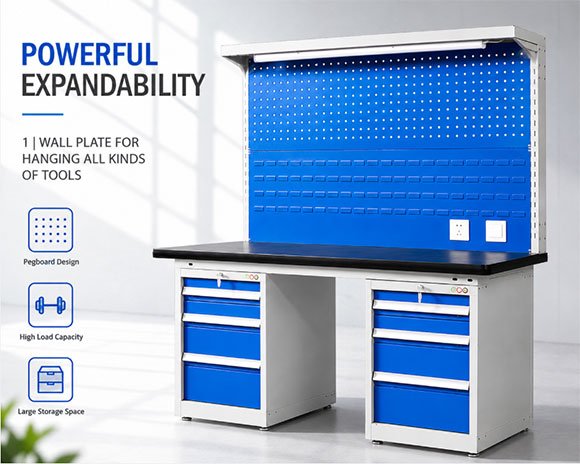
304 stainless steel
Around 8% nickel, 18% chromium — the “18/8” everyone knows. Corrosion resistance is the baseline. Food-grade lines, pharma washdown, daily disinfectant wipes — the surface doesn’t quit. Every food line we ship to the EU and Gulf states runs a 304 top.
Where Each Top Actually Belongs
Pick 201 when:
- General repair shops and tool rooms
- Dry storage and sorting stations
- Factory benches that don’t touch food and don’t get cleaned with chemicals
These stay dry and away from corrosives. 201 runs five or six years with no stress, and the price is honest.
Pick 304 when:
- Food-contact surfaces (prep, packing)
- Pharmaceutical GMP clean zones
- Chemical lab tops
- Coastal, high-humidity, salty air (Middle East oil camps, Southeast Asia waterfront plants)
These are either pinned by regulation or the environment is actively working against you. Going 201 there just costs more in rework.
201 vs 304 Stainless Steel Workbench|Three Questions Buyers Ask Most
Can 201 be used in a food factory?
Straight answer: not on a food-contact surface. Not because 201 is toxic — because it won’t survive food-grade frequent washing and weak acid-alkali. Once rust spots appear, hygiene inspection fails. Food plants should stay on 304. That’s the compliance floor.
Is 304 worth the extra cost over 201?
304 material costs more than 201, but the exact gap moves with the daily nickel price, so we don’t print a fixed number. Whether it’s worth it depends on the scenario — a dry tool room on 201 saves real money; a food GMP bay on 201 costs more in shutdown and remediation than the saving ever was. One line: save where you should, don’t save where you shouldn’t.
How different is the service life?
In dry conditions both last for years. The difference is how they fail: 201 rusts slowly, 304 basically doesn’t. Our warranty covers manufacturing defects, but how the material performs is up to the environment — which is exactly why we push by scenario, not by what’s cheap.
How It Fits with the Other Two Tops
Stainless is one of three surfaces we build:
- Anti-static laminate top — electronics assembly and labs, green vinyl surface, not Melamine;
- Steel plate top — mechanical, auto, heavy work, six options 2-10mm, takes impact and pressure;
- Stainless steel top — food, pharma, chemical, 201 or 304.
A plant usually mixes them: 304 stainless on the food packing line, 6mm steel in the repair bay next to it, anti-static on the office side. When you choose stainless, then decide 201 or 304 — the logic stays clean.
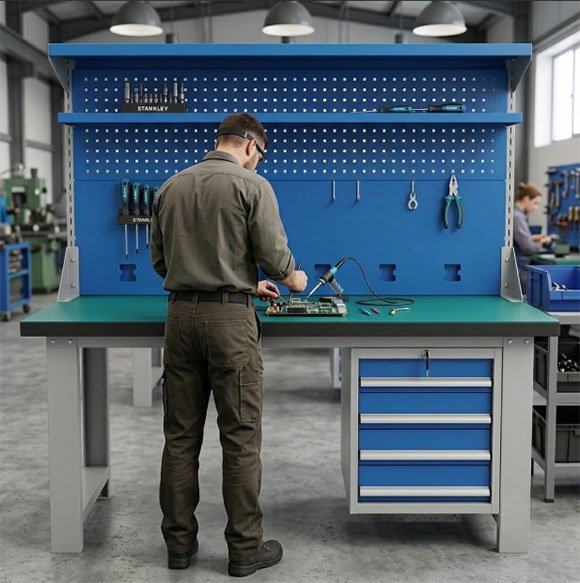
Material Limit Overseas Buyers Must Know
We’ll state this up front: on our stainless model, the top is 1mm stainless cladding; the cabinet underneath is still SPCC cold-rolled steel with powder coating. So the corrosion-resistant layer is the contact surface — the cabinet is not stainless. For heavy-corrosion sites like oil and mining, we recommend a separate full-unit discussion; don’t assume the whole bench is corrosion-proof just because the top is stainless. Say it clearly now, avoid the argument later.
Quick Recap
- Dry general workshop: 201 saves money, does the job.
- Food contact, pharma GMP, chemical: 304 is the compliance must.
- Humid coastal sites: go 304, don’t gamble on 201.
- Stainless top resists rust; cabinet is cold-rolled steel — heavy corrosion needs a full-unit plan.
- Say Rust Resistant, not Rust Proof.
Tell us your workshop type, whether it touches food, and how dry or wet the environment is. We return a config and quote within 24 hours.
FAQ
What is the MOQ for a stainless steel top workbench?
Both sample orders and full containers are workable. MOQ follows the configuration; tell us the model and we confirm.
What are your FOB terms?
We normally quote FOB and can discuss CIF/DDP by destination. Final terms go in the proforma invoice.
What warranty do you provide?
Manufacturing defects are covered under our standard warranty. Spare parts are supplied separately so a single component is easy to replace.
What after-sales support do you offer?
Our team answers installation and parts questions, and we keep common components in stock for repeat orders.
Do you support OEM / ODM?
Yes. OEM with your logo, ODM on configuration — pegboard layout, drawer count, lock type, light stands, all adjustable.
What is your production lead time?
Lead time varies with order size and customization. We give a confirmed date with the quotation.
How is the bench packaged for export?
KD flat-pack in cartons on pallets with corner protection. Sea volume runs about 40% under assembled, which cuts your freight.
Luoyang Hengna — 9 years building steel workshop furniture, CE certified, quote within 24 hours. Not a trading company; we run our own plant and powder-coating line.