Hospital janitor rooms are different from standard ones. Disinfectants go on the floor every shift. Humidity is high year-round. Regular cabinets don’t last.
You’re looking for something that handles bleach, drains wet mop water, and locks up cleaning chemicals. This is that cabinet.
Why standard cabinets fail in hospitals
A clinic in New York used regular steel cabinets for their cleaning tools. Housekeeping wiped floors with chlorine-based disinfectant daily. Splashes hit the cabinet. Within three months the door hinges seized from rust. In six months the legs corroded through. They replaced them all. The next ones rusted the same way the following year.
Plastic is worse. Some disinfectants make plastic brittle. Cracks show in six months. In a year the cabinet is scrap.
A hospital janitor room needs three things: chemical resistance, drainage, and a lock. Miss one and you’re buying replacements.
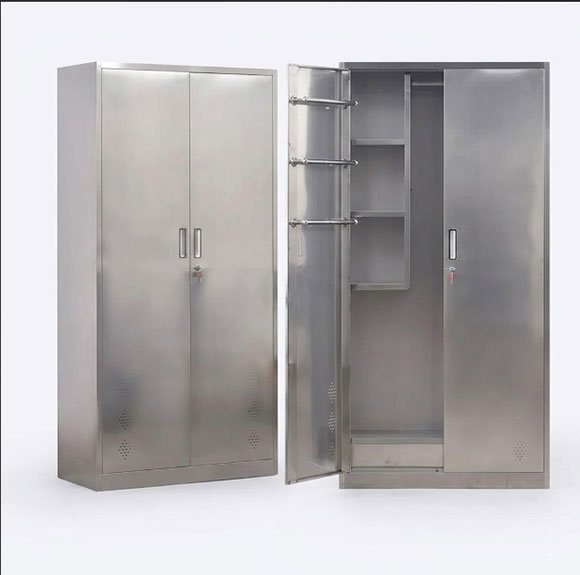
Hospital Cleaning Supply Cabinet — 304 Stainless Steel Specs
| Item | Spec |
|---|---|
| Material | 304 stainless steel (acid and alkali resistant) |
| Dimensions | W20 × D16 × H71 in (with leveling feet) / H66.5 in (body) |
| Door | Double door, key lock |
| Shelf spacing (top to bottom) | 11.8 / 15 / 13.8 / 3.9 in |
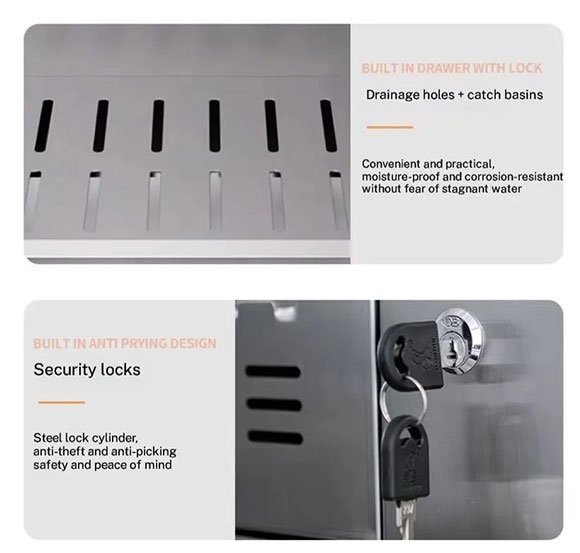
| Drainage | Bottom drain hole + removable drip tray |
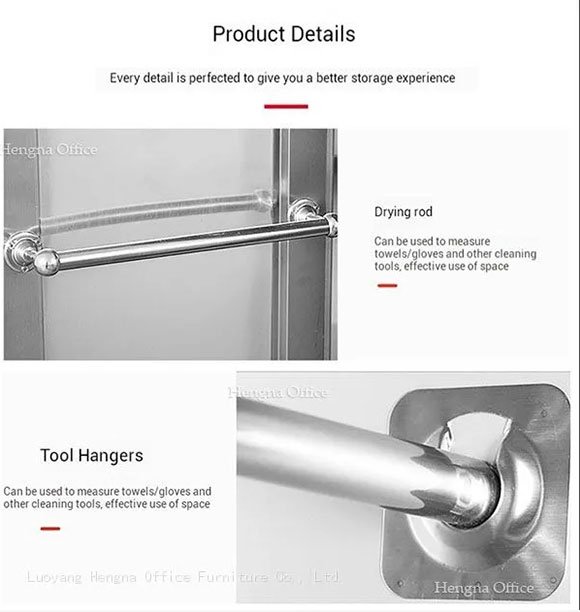
| Drying rod | Stainless steel bar, holds towels, gloves, sponges |
| Hooks | Side panel hooks for brushes, spray bottles, small tools |
| Lock | Steel cylinder, anti-pry |
Three features hospital buyers care about
① 304 stainless — handles disinfectants without rusting
The difference between 304 and 201 is nickel content. 304 contains 8%+ nickel, giving it natural resistance to acids and chlorides.
What hospital janitor rooms deal with daily: chlorine bleach, peracetic acid, alcohol sanitizers, cleaning chemicals. These splashes cause 201 stainless to show rust spots within six months. 304 doesn’t react.
A Dallas hospital client used 201 units initially. Within six months, rust appeared on the inside of the door — they were using high-concentration chlorine disinfectant. Switched to 304, problem gone. 201 isn’t bad. It’s just wrong for this environment.
② Drainage — chlorine water drains out, doesn’t pool inside
After mopping, the mop head drips chlorine-tainted water. In this cabinet, water drains down to the removable tray beneath. No pooling at the bottom, no mold.
Housekeeping pulls the tray out at end of shift and dumps it — 30 seconds. Chlorinated water doesn’t sit against the cabinet body, so 304’s anti-corrosion advantage is fully preserved.
③ Locked storage for disinfectants and tools
A hospital is public space. Patients, visitors, family members walk past janitor rooms daily. Disinfectants and cleaning tools can’t be accessible to everyone.
Steel cylinder lock, key management. The housekeeping supervisor holds the keys. Staff checks them out. This isn’t a plastic lock you can pop with a screwdriver.
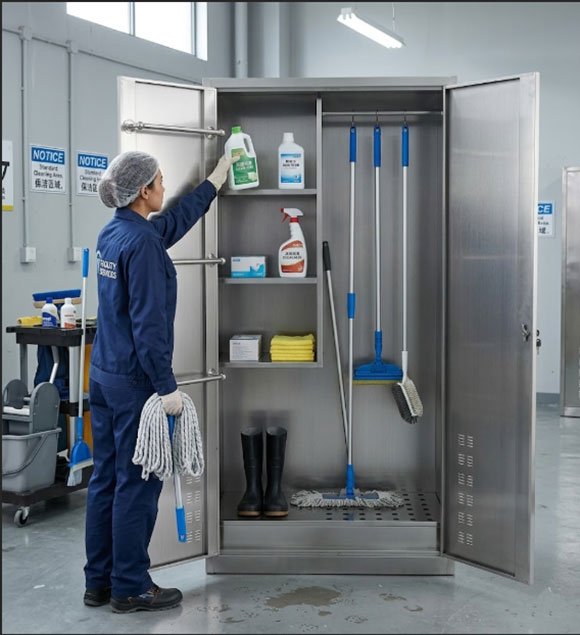
What goes in a hospital janitor cabinet
More than cleaning tools. A hospital janitor room also stores:
- Concentrated disinfectants and cleaners — bottles on the floor get kicked over. Locked in the cabinet, no spills.
- Backup mop heads and rags — wet ones hang on the drying rod, dry ones sit on shelves.
- Gloves, masks, PPE — hung on the rod, organized by type.
- Cleaning logs and inspection sheets — in the drawer, where they won’t get wet.
One cabinet sorts out the janitor room chaos. When JCI inspectors walk through, the janitor room should not be the reason you get flagged.
JCI and OSHA compliance
Hospital procurement has a non-negotiable: regulatory compliance.
JCI requirements for janitor rooms: cleaning tools and chemicals stored separately, drainage provided, access controlled.
OSHA requirements for chemical storage: labeled clearly, leak containment, restricted access.
This 304 stainless cabinet with drainage and lock meets all three. Hand this spec to your compliance team. They’ll recognize it immediately.
304 vs 201 — the honest answer
For medical environments: don’t try to save money on material. Go 304.
304 costs 30-40% more. But running 201 in a hospital janitor room costs more in the long run — shipping replacements, labor to swap them out, downtime. The cabinet is the cheap part.
| Environment | 201 | 304 |
|---|---|---|
| Hospital janitor room | No | Yes — daily disinfectants, must be 304 |
| Clinic / dental office | No | Yes — lower chemical concentration but constant exposure |
| Lab cleaning area | No | Yes — unknown chemicals, 304 is safest |
| Nursing home | Maybe | Recommended if budget allows |
| Standard office building | Yes | Overkill |
Not sure? Tell us what cleaners your housekeeping team uses. We’ll recommend the right grade. Won’t push the expensive one if you don’t need it.
Will it fit your janitor room
Cabinet width: 20 inches. Depth: 16 inches.
Standard US hospital janitor room minimum width is 36 inches. This cabinet fits with 16 inches of clearance. Doors open and close without hitting anything.
If your janitor room is tight — some older hospitals are only 30 inches wide — contact us. Custom sizing is available.
Measure before ordering: width, depth, height, and which way the door swings. Don’t let a cabinet get stuck at the door frame.
Common questions
Q: How long before 304 rusts? A: In a standard hospital janitor environment (chlorine disinfectant, normal humidity), 304 stainless lasts 10-15 years without rust. If the surface gets scratched, 304’s passive layer self-repairs the oxide film on contact with air.
Q: How often should the drip tray be emptied? A: For hospitals mopping 4-5 times daily, housekeeping should dump the tray at end of each shift. Takes 30 seconds.
Q: Does this cabinet meet JCI inspection standards? A: Separate chemical storage, drainage system, and access control — all three core JCI requirements are met. You can hand this spec to your compliance team during procurement.
Q: Will scratches cause 304 to rust? A: Light scratches are fine. 304 has a self-healing passive layer that reforms when exposed to air. For deep scratches, keep them clean and don’t let disinfectant residue sit in them.
Q: Minimum order? A: Samples: 1 unit. Bulk pricing: 10+ units for hospital projects. Contact us for a quote.
Q: Do you ship to the US and Europe? A: Yes. We export regularly. Sea freight packaging includes moisture-proof wrap, corner protectors, and reinforced crating. Arrival condition is above 99% based on shipping records.
One more thing hospital buyers should flag during procurement: lead time on medical-grade stainless cabinets. Standard powder-coated janitor cabinets ship in 2-3 weeks from most Chinese factories. 304 stainless with a drainage tray and custom internal layout typically takes 4-6 weeks. If you’re ordering for a new hospital wing that opens in three months, that’s fine. If you’re replacing cabinets that already failed and the JCI re-inspection is next month, you need to flag the timeline on the PO. Our janitor closet drainage guide covers what happens when the water problem isn’t solved first — even 304 stainless sitting in standing water develops issues at the base welds over time.
For hospital groups ordering across multiple facilities, ask about container consolidation. Ten cabinets for Hospital A plus twelve for Hospital B can share one 20-foot container, cutting per-unit freight by 40% versus two separate shipments. If the hospitals are in different countries, that math changes — but for same-country multi-facility orders, it’s the easiest money you’ll save on the entire PO. The freight savings alone often cover the cost of upgrading from 201 to 304 stainless.
About us
Luoyang Hengna Office Furniture Co., Ltd. — 9 years in steel furniture. Our clients include hospitals, clinics, and senior care facilities across North America and the Middle East. All medical-grade products carry CE certification and meet international healthcare procurement standards.
We work directly with our production base. No middlemen in the pricing. Response time beats traditional sourcing channels.
What you get:
- Direct-from-source pricing
- Warranty support for quality issues
- OEM available — custom logo, packaging, and sizing
Need a quote? Send your quantity and shipping destination. Response within 24 hours.