Before You Spend Big, Think About One Thing
When most small shop owners hear “tool management,” the picture that comes to mind is a full wall of tooling racks, RFID-tagged smart cabinets, and a five-figure investment.
Hold on.
How many machines are you running? Three? Five? Twenty or thirty holders total? At that scale, you don’t need a smart cabinet. You don’t need a custom system. You need something that holds, rolls, and locks — without the markup.
Here’s the problem: there isn’t much in between for small shops. On one end, plastic tool carts from the home improvement store — they can’t hold tool holders. On the other, industrial cabinets that cost more than your lathe. Nobody’s making stuff for the middle.
This isn’t a sales pitch. It’s a breakdown of what small shops actually need for tool holder storage, what they don’t, and where the money is worth spending.
What Disorganized Tooling Actually Costs a Small Shop
Time — Half an Hour a Day Isn’t Unusual
One operator spending 15–30 minutes a day looking for tools doesn’t sound like much. But that’s 6–13 hours a month. Multiply that by your shop rate. It adds up.
And while someone’s looking for a tool, the machine sits idle. Downtime waiting on a tool costs more than the tool itself.
Holders — One Drop, and Taper Accuracy Is Gone
Tool holder tapers are precision surfaces. One clang against another holder, one drop on the concrete floor, and runout shifts. You can say “I’m careful,” but holders stacked on benches knock into each other, slide toward the edge — things you can’t control.
How much is a BT40 holder? A few hundred to over a thousand. Damage one, and it’s scrap. Damage three in a year, and you’ve paid for a storage cart.
5S — It’s Not About Looking Good, It’s About Working Fast
A messy shop isn’t just “ugly.” It means slower searches, more lost items, longer onboarding for new operators. Clean up the tooling, and those hidden costs drop.
What a Small Shop Actually Needs
Don’t get distracted by “smart” and “digital.” Small shop tool holder storage comes down to three things:
| Need | Why |
|---|---|
| Holders have a fixed spot | Find by looking, not by digging |
| Small parts can be locked | Inserts, pull studs, and wrenches don’t walk off |
| Cart rolls to the machine | No carrying holders across the shop |
That’s it. Any setup that hits these three doesn’t have to cost a fortune. Anything that misses them isn’t worth five figures either.
What You Don’t Need to Spend Money On
RFID Tags and Smart Management Systems
Big shops run tool management systems with RFID tags on every holder, software tracking usage counts and remaining life. Sounds impressive.
But if you’ve got a handful of machines and a couple dozen holders, the veteran machinist already knows which tool is where and when it’s due for replacement. The cost of the system — and the time to learn it — could buy your inserts for a year.
When do you need it? When you’re tracking hundreds of tools, scheduling across multiple shifts, or managing inventory across bays. That’s not a small shop anymore.
A Full Wall of Fixed Tooling Racks
Fixed tooling libraries hold a lot, protect well, and look impressive. But there’s a catch: your tools don’t move.
In a small shop, machines aren’t lined up in a row. Today you’re on Machine #3, tomorrow on #5. A fixed rack on the wall means walking over every time you need a tool. How is that different from a tool crib in the back?
When do you need it? When machines are stationary, tools don’t move, and operators walk to the rack. That’s a production line, not a job shop.
Brand Premium
Some imported brands sell a single tool cabinet for the price of a used car. Is it good? Sure. But do your twenty-odd holders need a cabinet that costs as much as a machining center?
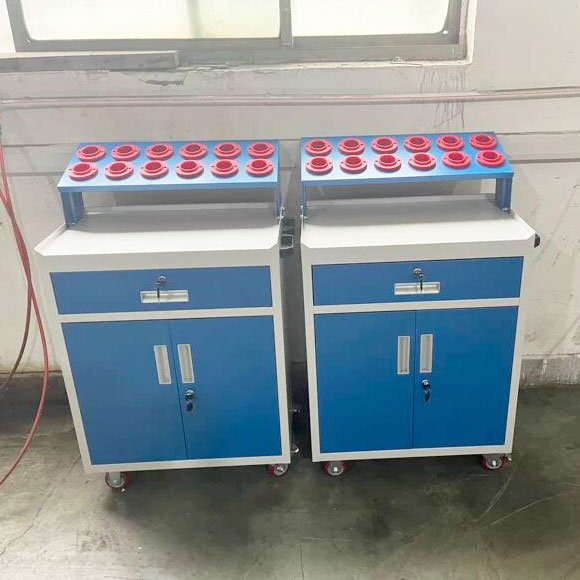
Cold-rolled steel, ABS trays, locking drawers, swivel casters — none of this requires a brand name to work. The material and build quality either hold up or they don’t. The price gap is several times over for the same function.
What a Practical Setup Looks Like
ABS Trays — Holders Stand Up, Not Lying Down
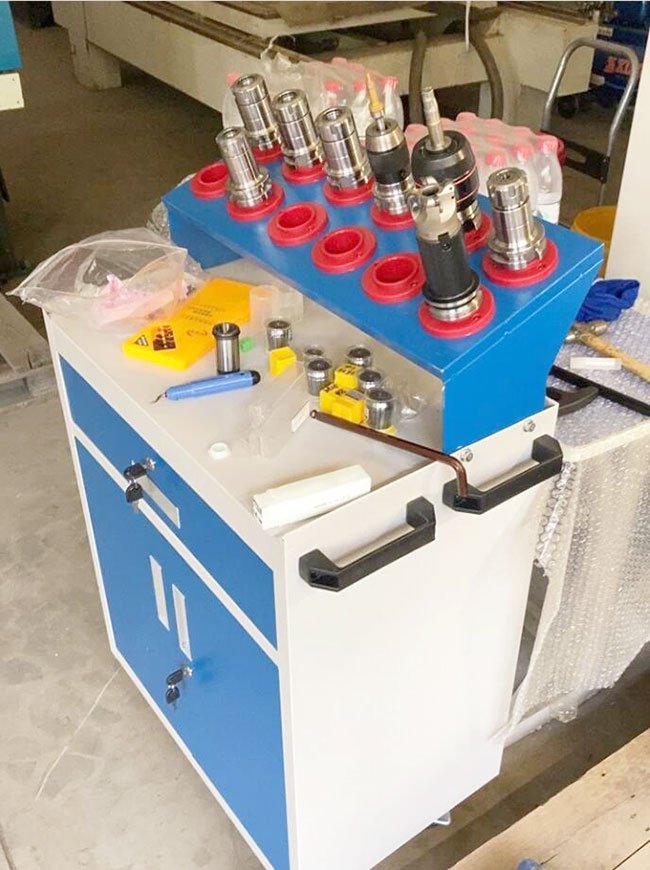
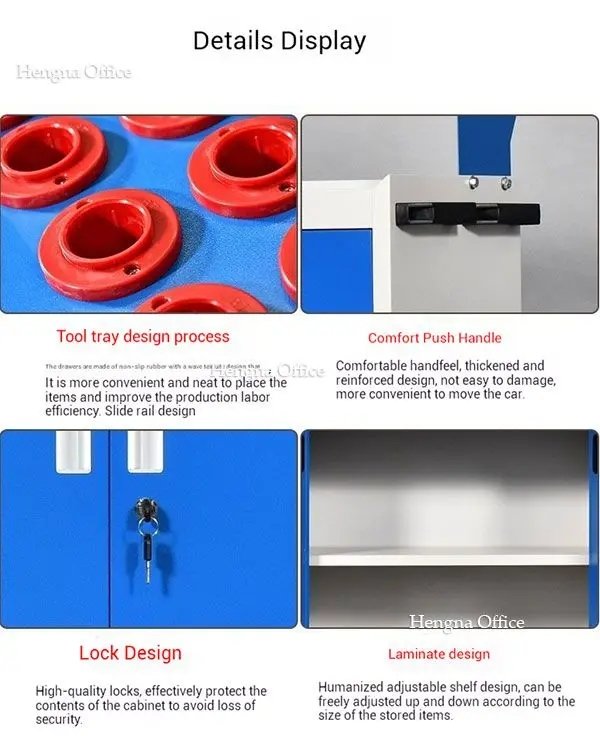
ABS injection-molded trays with wavy groove patterns. Holders slot in and stay upright — no tipping, no sliding. Open top deck means you see every holder at a glance.
Why does ABS material matter? Trays made from recycled plastics crack and warp within months. Virgin ABS doesn’t.
Why wavy grooves? Flat trays let holders wobble. Tapers clank against each other. The grooves keep holders separated and still.
Cold-Rolled Steel Body — Five Years, No Sag
The cabinet is cold-rolled steel, not thin sheet metal. Drawer slides are steel, not plastic. Welds are continuous, not spot-welded.
Five years in, drawers pull out without slop, doors close without sagging. Not a vanity thing — it’s a replacement thing. You don’t want to buy a new cabinet every two years.
Swivel Casters — The Cart Follows the Work
Fully loaded with holders, one person can push this cart across the shop. Casters have brakes — push it to the machine, step on the brake, it stays put. Next setup, push it to the next machine.
In a small shop with a few machines, one cart that moves around beats three fixed cabinets at a fraction of the cost.
Locking Drawers — Small Stuff Stops Disappearing
Inserts, pull studs, wrenches, gauges — toss them in the drawer, lock it at the end of shift. Next morning, unlock. Everything’s where you left it.
Not high-tech. But it solves a daily headache.
Tool Holder Storage For A Small CNC Shop|Do the Math for Your Shop
I’m not going to throw made-up numbers at you. But you can estimate for yourself:
| Cost Item | Your Number |
|---|---|
| Holders damaged in a year — replacement cost? | _____ |
| Daily search time × shop rate × 250 work days? | _____ |
| Small items lost and re-ordered annually? | _____ |
| Time spent on 5S fire drills? | _____ |
Add them up. Compare to the cost of a storage cart.
You don’t need exact numbers to see it: if you damage two or three holders a year, the cart pays for itself.
FAQ
Q: I only have two machines. Is a cart worth it?
Two machines makes it more important, not less. Fewer holders means each one is harder to replace when it goes missing. A fixed spot for every holder turns search time from minutes to seconds.
Q: Why are the trays red?
In dim shop lighting, red stands out. You can scan the tray and spot each holder instantly. It’s functional, not decorative.
Q: I have a mix of BT30 and BT40 holders. What do I do?
Different taper diameters work best in separate trays. Top tray matched to your primary holder type, internal shelf for the rest. Contact us and we’ll configure it to your actual tooling.
Q: How many holders does it hold?
Depends on the holder type and how they’re loaded. Contact us with your specific holders and we’ll give you a straight answer.
Q: How does export shipping work?
Sea freight, air freight, or rail — we handle all three. Fully assembled or knock-down packaging, based on your destination. Knock-down saves on freight, and reassembly isn’t complicated.
Q: Does cold-rolled steel rust?
Surface is painted. Normal shop environments (no acid or alkali exposure) won’t cause rust. If the shop is particularly damp, occasional wiping down is a good idea.
Bottom Line
Small shops don’t need big systems, expensive cabinets, or electronic tracking. You need holders with a place, small parts that stay put, and a cart that rolls.
Get those three things right without spending a fortune, and it’s worth it.
The problem a five-figure system solves is the same one a practical setup solves. The difference is how much extra you paid to not spend time thinking about it.
Contact us — tell us about your shop. How many machines, what holder types. We might recommend something, or we might tell you it’s not the right fit. Either way, you’ll get a straight answer.