The Nightmare of Small Parts Organization
If you’ve ever worked in a workshop, you know this pain:
Screws, nuts, washers, seals, springs, clips… These small parts seem worthless individually, but when you can’t find them when needed, that’s when it really hurts.
I’ve talked to many workshop supervisors, warehouse managers, and auto repair shop owners, and they consistently mention one problem: small parts organization seems simple, but it actually greatly affects efficiency.
One auto repair shop owner told me: “My wrenches and sockets all have fixed positions. But these small things like screws and nuts, they always end up messy. Once, I spent 15 minutes looking for an M8 nut, and finally found it had fallen into a corner.”
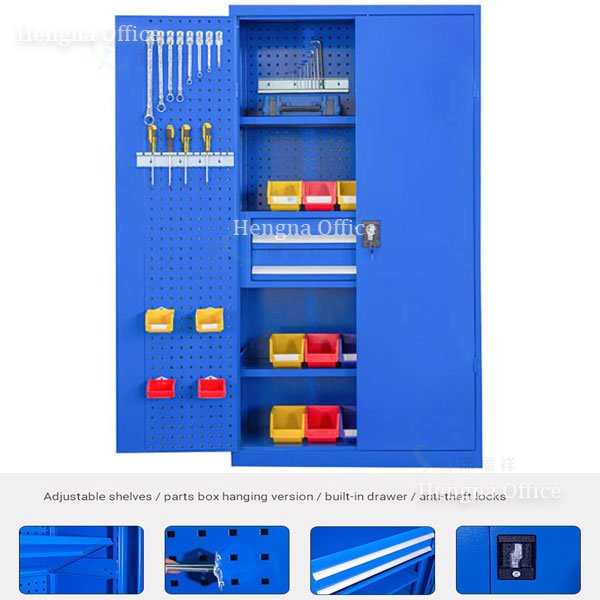
So today, I want to seriously discuss: How to choose between parts bin systems and drawer systems? More importantly, our product doesn’t force you to “choose one or the other,” but offers a hybrid solution of drawer tool cabinet + optional door-mounted parts bins. This article will detailedly compare the two systems and explain why a “hybrid solution” might be the better choice.
I. What is a Parts Bin System?
1. Basic Structure
A parts bin system, simply put, is: using multiple independent small bins to categorize and store small parts.
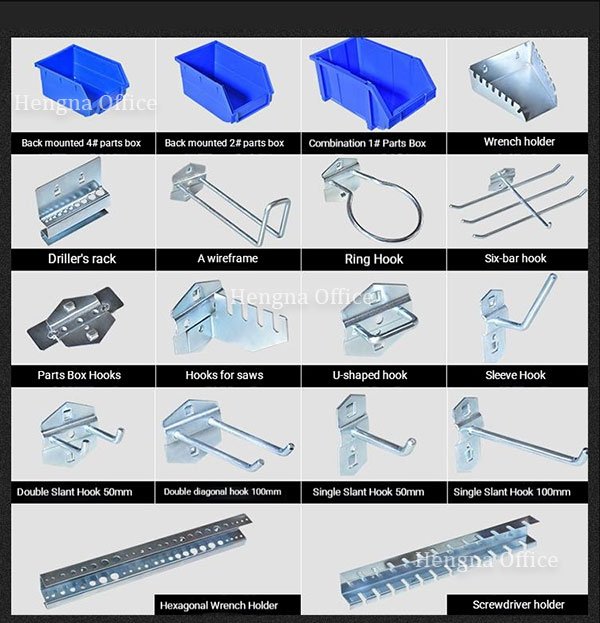
These small bins are called “parts bins,” typically made of plastic, and come in different sizes:
- Small size: Suitable for screws, nuts, washers (50×100×75mm)
- Medium size: Suitable for seals, clips, small accessories (100×150×100mm)
- Large size: Suitable for larger accessories (150×200×120mm)
2. Installation Methods for Parts Bins
Parts bins can be installed in different locations:
Method 1: Hang on pegboard
- Install pegboard on the wall
- Parts bins have hooks on the back, hang on pegboard
- Advantage: Flexible, can adjust position anytime
Method 2: Place on shelves
- Install shelves in cabinet or racking
- Parts bins placed directly on shelves
- Advantage: Stable, suitable for heavy items
Method 3: Hang on door panel interior (our optional solution)
- Install hook system on the interior of the tool cabinet door panel
- Parts bins hang on the door panel
- Advantage: Doesn’t take up internal space, visible as soon as you open the door
3. Suitable Scenarios
Scenario 1: High-frequency access small parts If you need to access screws and nuts dozens of times a day, a parts bin system is very suitable. Because of the open design, you can see them at a glance and grab them with one reach.
Scenario 2: High classification requirements For example, in auto repair shops, you need to categorize screws of different specifications: M6, M8, M10 stored separately, metric and imperial stored separately, stainless steel and carbon steel stored separately. The color + label system of parts bins can well meet this need.
II. What is a Drawer System?
1. Basic Structure
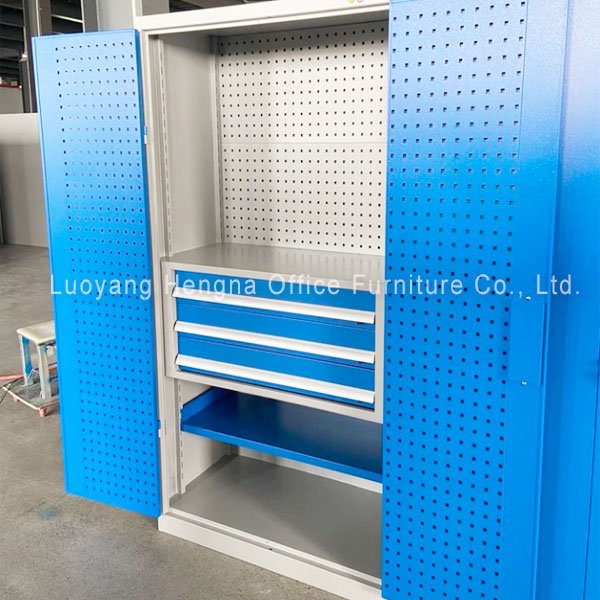
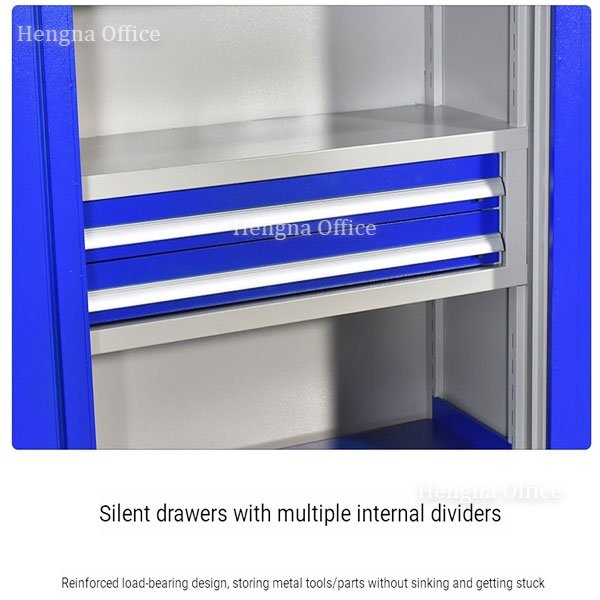
A drawer system is simply a tool cabinet/parts cabinet with multiple drawers. Each drawer can be divided into several compartments to store different parts.
Features of our drawer tool cabinet:
- Cold-rolled steel cabinet body , sturdy and durable
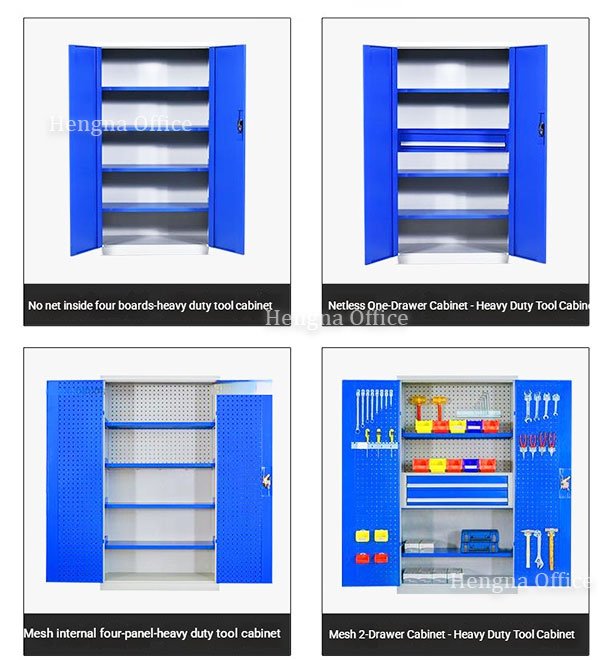
- Optional drawer quantity: 1, 2, or 3 drawers (customized according to needs)
- Drawer dividers (adjustable), adjust compartment size according to needs
- Silent slides (three-section ball bearing slides), smooth pulling, no jamming
- Full-extension design, drawers can be fully opened to access items at the back
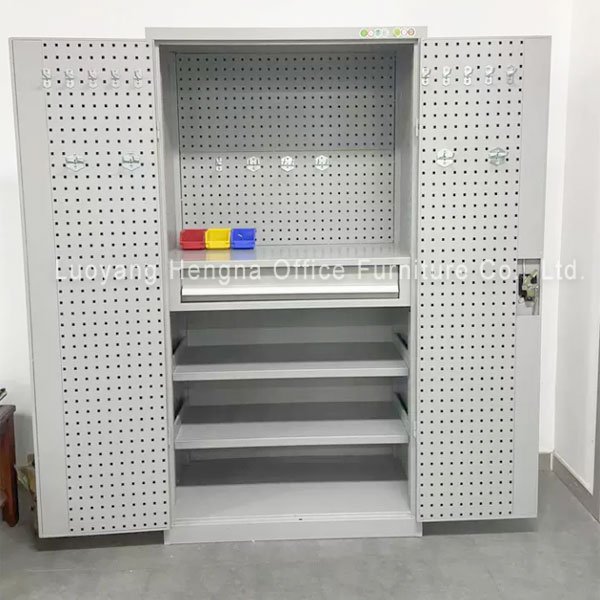
- Optional parts bins: Door panel interior can add hanging parts bins (optional accessory)
2. Suitable Scenarios
Scenario 1: Precision parts storage If you store precision parts (such as electronic components, bearings, seals), a drawer system is more suitable. Because of the closed design, it’s dust-proof and loss-proof.
Scenario 2: Scenarios requiring weighing In some workshops, parts need to be accessed by weight (for example, taking 100 grams of screws each time). Drawers can be taken out entirely for weighing, which is not convenient with parts bins.
Scenario 3: High-value parts If parts are relatively expensive (such as imported bearings, special seals), drawers can be locked (with lockable drawers), while parts bin systems are not as secure.
III. Parts Bin System vs. Drawer System: 6-Dimension Comparison
| Comparison Dimension | Parts Bin System | Drawer System |
|---|---|---|
| Access Speed | ⭐⭐⭐⭐⭐ (Very fast, visible at a glance) | ⭐⭐ (Need to open drawer) |
| Dust-proof Effect | ⭐ (Open design, easily collects dust) | ⭐⭐⭐⭐⭐ (Fully enclosed) |
| Classification Flexibility | ⭐⭐⭐⭐⭐ (Bins can be adjusted freely) | ⭐⭐⭐ (Dividers adjustable, but limited) |
| Multi-person Sharing | ⭐⭐⭐⭐⭐ (Parallel access) | ⭐⭐ (Possible “drawer contention”) |
| Load-bearing Capacity | ⭐⭐⭐⭐ (Each bin’s load capacity is limited) | ⭐⭐⭐⭐⭐ (Each drawer can hold heavy items) |
| Price | ⭐⭐⭐⭐ (Relatively cheap) | ⭐⭐⭐ (Slide costs are high) |
IV. Technical Specification Comparison: Parts Bin System vs. Drawer System vs. Our Hybrid Solution
| Specification | Parts Bin System | Drawer System | Our Hybrid Solution (Drawer + Optional Parts Bins) |
|---|---|---|---|
| Load Capacity (per unit) | 5-10kg | 20-30kg | Drawer 20-30kg + Door Parts Bins 5-10kg |
| Dust-proof Rating | Low (open design) | High (fully enclosed) | Hybrid (drawers dust-proof + parts bins open) |
| Access Speed | Fast (3 seconds) | Medium (5 seconds) | Hybrid (parts bins fast + drawers medium) |
| Suitable Part Types | Screws, nuts, small accessories | Precision parts, high-value parts | Both precision parts and high-frequency small parts |
| Configuration Flexibility | Medium (bins adjustable) | Low (drawer dividers limited) | High (optional drawer quantity, optional parts bins) |
| Multi-person Sharing | Suitable | Not suitable | Suitable (parts bins allow parallel access) |
| Maintenance Required | Low (replace damaged bins) | Medium (slides need regular cleaning) | Medium (both bins and slides need maintenance) |
Explanation:
- Our product is a drawer tool cabinet, standard configuration has 1-3 drawers (optional)
- Door panel parts bins are optional accessories, customers can choose whether to add them according to their needs
- The advantage of this “hybrid solution” is: it has both the dust-proof and load-bearing capacity of drawers, and the quick access and classification flexibility of parts bins
V. Why Not “Choose One or the Other,” But “Combine Both”?
1. Limitations of Traditional Solutions
Using only parts bin system:
- ❌ Poor dust-proof effect (open design)
- ❌ Not suitable for precision parts (easily lost, easily collects dust)
- ❌ High-value parts not secure (easily stolen)
Using only drawer system:
- ❌ Slow access speed (need to open drawer each time)
- ❌ Multi-person sharing leads to “drawer contention”
- ❌ Higher price (slide costs)
2. Our Solution: Drawer Tool Cabinet + Optional Door Panel Parts Bins
Core Idea:
- Drawer system: Placed in lower or middle layer of tool cabinet, for storing precision parts, high-value parts
- Parts bin system: As optional accessory, hung on door panel interior, for high-frequency access small parts
- Flexible configuration: Customers can choose 1-3 drawers, and also choose whether to add parts bins
Specific Configuration Examples:
- Basic Version: Only drawers (1-3 drawers, according to needs)
- Upgraded Version: Drawers + door panel parts bins (add hanging parts bins on door panel interior)
- Custom Version: According to workshop needs, customize drawer quantity and parts bin configuration
VI. Real Cases: Choices of 3 Overseas Customers
Case 1: Auto Repair Shop (Ohio, USA)
Background: Owner does General Repair, workshop has 2 mechanics, needs to use various screws, nuts, washers daily.
Choice: Upgraded Version (2 drawers + door panel parts bins)
Configuration Details:
- Drawers: 2 drawers, store precision parts (bearings, seals)
- Door panel parts bins: 12 medium-sized parts bins, separately store M6, M8, M10 screws
Customer Feedback:
- “Drawers store precision parts, dust-proof effect is good.”
- “Door panel parts bins store high-frequency access screws, access speed is fast.”
- “One small problem: Door panel parts bins are optional accessories. I didn’t buy them at first, later found I needed them, and bought them separately. If I had known about this option from the beginning, I would have bought them together.”
Imperfect Details:
- “After the door panel parts bin hooks are installed, the door is a bit heavy, needs force to open and close.” (Customer’s exact words)
- “Parts bins are plastic. Once, it was bumped by a wrench, and a crack appeared.”
Conclusion: Suitable for auto repair shops that need to store both precision parts and high-frequency access small parts.
Case 2: Electronic Manufacturing Workshop (Munich, Germany)
Background: Factory produces industrial control boards, needs to store resistors, capacitors, integrated circuits (ICs), connectors, and other precision parts.
Choice: Basic Version (3 drawers, didn’t choose parts bins)
Configuration Details:
- Drawers: 3 drawers, each drawer divided into 12 compartments using dividers
- Why didn’t choose parts bins: Precision parts cannot collect dust, closed design of drawers is better
Customer Feedback:
- “Precision parts cannot collect dust, drawer system dust-proof effect is good.”
- “Some ICs are anti-static, we added anti-static mats inside the drawers ourselves.”
- “3 drawers are enough, don’t need parts bins.”
Imperfect Details:
- “After using the drawer slides for a year, one drawer is a bit tight when pulling, maybe dust got in.” (Maintenance issue)
- “Dividers are plastic, they break easily when adjusting. We prepared 10 replacement pieces.”
Conclusion: Suitable for manufacturing workshops with high precision parts and dust-proof requirements (don’t need parts bins).
Case 3: Warehouse Spare Parts Management (Sydney, Australia)
Background: Logistics company warehouse, needs to manage thousands of spare parts (screws, nuts, seals, light bulbs, fuses, etc.).
Choice: Upgraded Version (1 drawer + door panel parts bins)
Configuration Details:
- Drawer: 1 drawer, stores high-value parts (fuses, relays)
- Door panel parts bins: 24 small-sized parts bins, store screws, nuts, washers
Customer Feedback:
- “High-value parts stored in drawers, can be locked, secure.”
- “High-frequency access items like screws and nuts, stored in door panel parts bins, access speed is fast.”
- “1 drawer + door panel parts bins, cost-performance is high.”
Imperfect Details:
- “The hooks for the door panel parts bins, need to align with the holes during installation, a bit troublesome. We spent half an hour installing them.”
- “Parts bins are transparent, after one year of use, a bit scratched, not very clear to see.”
Conclusion: Suitable for warehouses with many types of parts and large differences in access frequency (hybrid configuration).
VII. How to Choose? Match According to Scenarios
Choose “Basic Version” (only drawers), if you:
✅ Mainly store precision parts (electronic components, bearings, etc.)
✅ Have requirements for dust-proofing and loss prevention
✅ Parts are high-value, need locked management
✅ Don’t need high-frequency access to small parts
Recommended Configuration: 2-3 drawers (according to number of part types)
Choose “Upgraded Version” (drawers + door panel parts bins), if you:
✅ Need to store both precision parts and high-frequency access small parts
✅ Hope for flexible configuration (drawers for precision, parts bins for high-frequency)
✅ Have sufficient budget, willing to pay for convenience
✅ Workshop space is limited, hope one cabinet solves all problems
Recommended Configuration: 1-2 drawers + 12-24 door panel parts bins
Choose “Custom Version” (customized according to needs), if you:
✅ Have special requirements (such as drawer quantity, parts bin quantity)
✅ Workshop space is special (need non-standard sizes)
✅ Need bulk purchasing (10+ units)
Customization Process:
- Provide workshop floor plan and requirements list
- We produce configuration plan (drawer quantity, parts bin quantity, dimensions)
- Confirm plan, place order for production
- Delivery time: Standard products 15 days, customized products 25 days
VIII. Frequently Asked Questions (FAQ)
Q1: Are door panel parts bins standard? A: No. Door panel parts bins are optional accessories, customers can choose whether to purchase them according to their needs. We recommend: If you frequently access screws, nuts, and other small parts, purchasing door panel parts bins will greatly improve efficiency.
Q2: Can drawer quantity be customized? A: Yes. Standard configuration is 1, 2, or 3 drawers. If you need more drawers, customization is possible. But note: The more drawers, the more the cabinet height needs to increase.
Q3: Do door panel parts bins break easily? A: Depends on usage intensity. If in an auto repair workshop, where wrenches often bump into the bins, plastic bins may develop cracks after 1-2 years. We recommend checking once a year, promptly replace damaged bins.
Q4: Do drawer slides break easily? A: If using three-section ball bearing slides, they won’t break under normal use for 3-5 years. But if the workshop has a lot of dust, you may need to clean the slides once every six months.
Q5: Can parts bins be placed outdoors? A: Not recommended. Parts bins are plastic and will age with long-term UV exposure. If using outdoors, we recommend choosing an all-steel drawer system (no parts bins).
Q6: What is the delivery time? A: Standard products (1-3 drawers, no parts bins) delivery time is 15 days. Customized products (adding door panel parts bins, or non-standard sizes) delivery time is 25 days. For overseas customers shipping by sea, typically 20-30 days to arrive.
IX. No Overselling: This “Hybrid Configuration” Also Has Limitations
Limitation 1: Door Panel Parts Bin Hooks May Loosen
Some customers feedback: “After using the door panel parts bin hooks for a while, they loosen, and the parts bins wobble.”
Our improvement plan: For the new generation of products, the hooks have added lock nuts, which don’t loosen easily. But older models indeed had this problem.
Limitation 2: Door is a Bit Heavy
If the door panel has 24 parts bins hung on it, the door will be heavy, and needs force to open and close. One customer said: “My wife helped me move the tool cabinet, she couldn’t open the door (too heavy).”
Our suggestion: If choosing door panel parts bins, we recommend choosing the version with damping hinges (optional accessory), which makes opening the door easier.
Limitation 3: Parts Bins are Plastic and Easily Cracked
This is a common problem for all parts bins, not just our product. Plastic bins will age and crack with long-term use. Need regular replacement.
Our improvement plan: We are testing PP material parts bins (more impact-resistant than ordinary plastic), expected to launch next year.
Limitation 4: Requires Maintenance
Parts bin systems need regular checks for damaged bins; drawer systems need regular cleaning of slides. Compared to the ideal state of “buy and use, no maintenance needed,” this product requires a bit of maintenance.
But we think: a little maintenance in exchange for 10 years of service life is worth it.
X. No “Best,” Only “Most Suitable”
Parts bin systems and drawer systems have no absolute “which is better,” only which is more suitable for your scenario.
Our product philosophy is: Don’t force you to “choose one or the other,” but let you flexibly configure according to your needs:
- Need precision storage? Add drawers.
- Need quick access? Add door panel parts bins.
- Need both? Upgraded version (drawers + parts bins).
One last thing: Many customers ask “can it be customized?” — Yes. Our drawer tool cabinets, drawer quantity (1-3), and parts bin configuration can all be adjusted according to needs. If you have special requirements, you can contact us, provide workshop floor plan and requirements list, and we’ll help you design a solution.