Job Shops and Production Lines Don’t Manage Tools the Same Way
A production line runs the same part all day, tools set once and left alone for months. A job shop is different — milling in the morning, boring in the afternoon, something entirely different tomorrow. Tool setups change constantly. The holder you need today gets swapped out by noon.
What does that mean? Your tool holders can’t sit locked in one spot. They need to be reachable, adjustable, and movable — on demand.
This cart is built around that reality. Open tray on top — glance and grab. Adjustable shelf — shift it when your tool mix changes. Swivel casters — the cart follows the work, instead of you hauling holders back and forth.
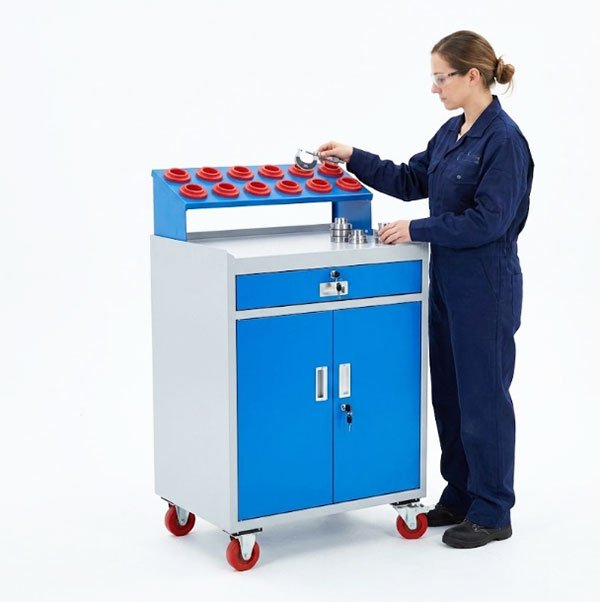
Morning in a Job Shop
7:30 AM. Machine #3 has a new job. Needs a BT40 end mill and a drill.
The machinist walks up to the cart. Top tray is wide open — every holder in plain sight. Spots the mill, pulls it, walks to the machine. No doors, no bending down, no digging through drawers.
8:15. The drill has gone dull. Swap it out. The replacement is right there on the top tray, two slots over. Grab and go.
10:00. Line change. Machine #3’s run is done, moving to #5. Push the cart across the shop, step on the brake — the cart is now stationed at #5, ready for the next setup.
5:30 PM. End of shift. Lock the drawers. Inserts, pull studs, wrenches — all secured. Tomorrow morning, everything is where you left it.
Why an Adjustable Shelf Matters in a Job Shop
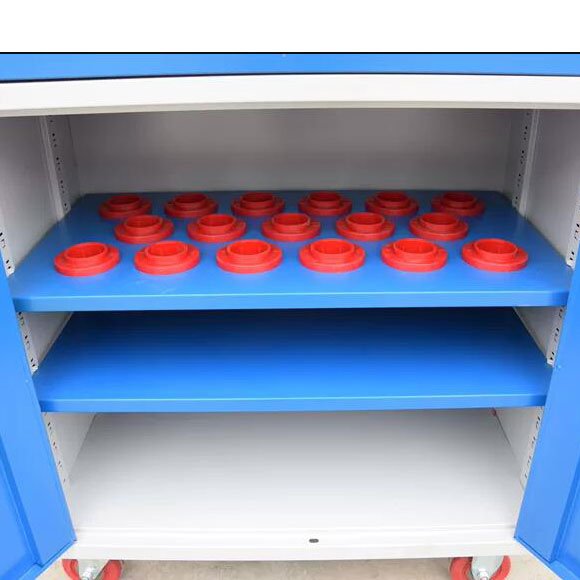
On a fixed production line, tool types don’t change. You set the shelf once and forget it. In a job shop, that logic doesn’t hold. One week it’s mostly milling. Next week it’s turning. Tool sizes and fixture types shift with every new order.
The adjustable shelf lets you adapt storage to the work at hand:
- Heavy milling week — drop the shelf a notch, make room for larger tool trays
- Turning-heavy week — raise the shelf, free up space for gauges and accessories
- Rush job lands — pull the shelf out, slide in a pre-loaded tool box and roll straight to the machine
No new cart, no extra cabinet. Adjust the shelf and keep going.
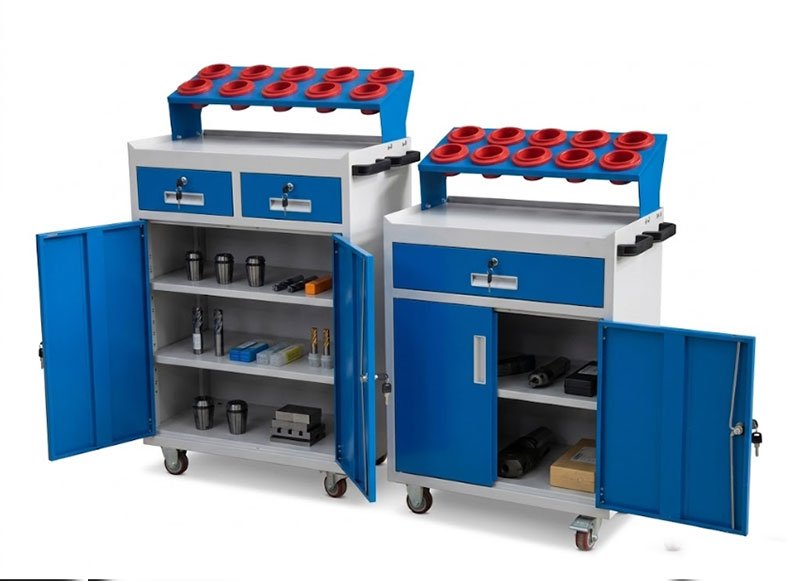
Locking Drawers Aren’t a Nice-to-Have
Job shops have a problem: lots of small items, and small items walk off.
Inserts, pull studs, wrenches, presetters — individually cheap, collectively expensive when they go missing. And in a shop with day and night shifts trading hands, a tool left on a bench at 5 PM might not be there at 7 AM.
Locking drawers solve one thing: certainty. Put it in, lock it, come back tomorrow — it’s still there.
No time wasted hunting. No reordering. No shift delayed because a pull stud walked.
Rolling It Around Matters More Than You Think
Job shops have multiple machines, mixed jobs, frequent changeovers. If your tool holders stay in one fixed spot, every line change means carrying holders across the shop — time lost, holders dinged.
This cart, fully loaded with holders, rolls with one adult pushing it. Braked casters hold it steady wherever you park it.
Real workflow:
- Running Machine #3? Cart stays next to #3
- Afternoon run on #5? Push it over
- Tomorrow on the other row? Push it again
The cart follows the work. The holders never leave the cart. Fewer hand-offs, fewer chances to drop one.
Rolling Tool Holder Cart with Locking Drawers Specifications
| Item | Specification |
|---|---|
| Tray material | ABS injection-molded, red, wavy anti-slip grooves |
| Tray layout | Open top tray + enclosed internal tray (double-deck) |
| Cabinet material | Cold-rolled steel, blue finish |
| Drawers | 3–5, lockable, steel slides |
| Shelf | Adjustable height |
| Casters | 4-inch industrial swivel, braked |
| Side hooks | Standard |
| Approx. dimensions | 800×600×1200mm (confirm with actual unit) |
Is This Cart Right for Your Shop?
Good fit if:
- Job shop with tool setups changing frequently
- Multiple machines sharing a common tool set — need flexible deployment
- Limited floor space, no room for a fixed cabinet
- Day and night shifts alternating — need lockable storage
Less ideal if:
- Fixed production line, tools unchanged for months — a stationary tool cabinet makes more sense
- Single-part high-volume runs — you don’t need mobility or adjustable shelving
FAQ
Q: Is the adjustable shelf hard to change?
Not at all. Loosen the screws, move the shelf to the target height, tighten. Takes under a minute.
Q: How do we handle drawer keys across shifts?
Keys are standard. You can key all drawers alike for shared access, or key them individually — whatever fits your shop’s management policy.
Q: Do the brakes hold when the cart is parked next to a machine?
Yes. Step on the brake — the cart locks in place, no drifting. Step again to release and roll.
Q: How many carts do I need for my shop?
One cart per machining center is a good rule of thumb. If machines are far apart, one per machine saves you pushing carts back and forth.
Q: How is export packaging handled?
Sea freight, air freight, or rail — we’ve shipped all three. Can pack fully assembled or knock-down, based on your preference. Knock-down saves on freight and reassembly is straightforward.
Q: Can I customize the configuration?
Drawer count, shelf positions, cabinet color — all adjustable per order. For batch orders, talk to the factory directly.
Q: How do I place an order?
Contact us with your requirements — holder types, quantities, any special needs. We’ll send a configuration proposal and quote.
Three Questions to Decide
Ask yourself:
- Do your tool setups change often? — If yes, the adjustable shelf and open tray are for you
- Do you move tools between machines? — If yes, the swivel casters are for you
- Do small accessories tend to disappear? — If yes, the locking drawers are for you
Two out of three? This cart is worth it.
Contact us — tell us about your shop. We’ll give you a straight answer, not a sales pitch. If it doesn’t fit, we’ll say so.