Two products get sold under one name, and the buyer who has been sold the wrong one usually finds out about eighteen months later.
A roller cabinet is a floor-standing unit on castors with deep drawers. A top chest is a shallow drawer box that sits on top of it. They are sold together, they are priced separately, and one of them is bought first. Which one that is matters a great deal to anybody stocking them.
Get the definitions straight first
The two formats do different jobs and the difference is not cosmetic.
A top chest is shallow by design. Its drawers graduate in depth, shallow at the top for sockets and small drivers, deeper at the bottom for spanners and pliers. That graduation only works if the chest sits at working height. On its own on a bench it works. Anywhere else it does not.
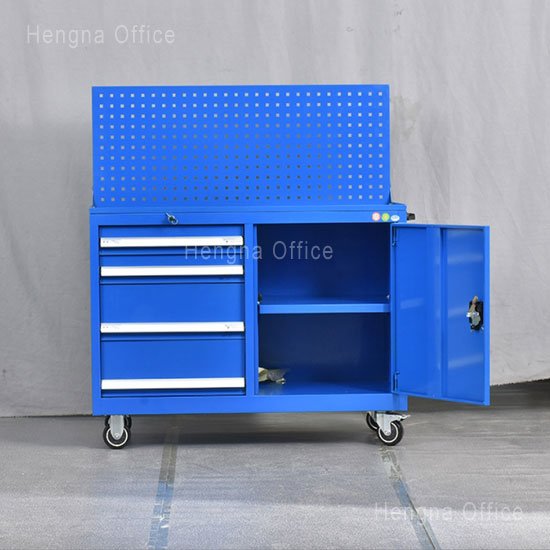
A roller cabinet is the base. Its drawers are deeper and fewer, it stands on the floor, and it carries the load: power tools, battery packs, the heavy stuff that would sit on a chest and stay there. It also rolls, which is why it is called a roller cabinet in the first place. Stacked, the two give the standard mechanic’s build: cabinet on the floor, chest on top, heavy stock below and the tools used most within reach.
The buying order is not a preference
Almost every technician setting up a new workshop buys in the same sequence. First a roller cabinet, because that is what holds the tools. Then, weeks or months later, a top chest, because once the tools are stored the next problem is that the ones used most are still at the bottom.
That sequence is why distributors who stock the base format do better on repeat business. The chest is the follow-on purchase, and the base is what puts the supplier’s name in the workshop. A supplier stocking only chests is selling the second purchase into a market that has not made the first one yet.
It also changes how you present the pair. A roller cabinet stands on its own in a catalogue and reads as a complete product. A top chest photographed alone looks like an accessory, because functionally it is one.
What actually decides whether the format sells
Format matters less than four specifications. These are the four that come back in complaints, and all four are checkable before you buy.
The slides. This is the part that fails first and it fails on the first loaded drawer, not after years. Friction slides are two pieces of steel rubbing against each other. They are fine on an empty cabinet. Load one with 20 kg of sockets and you will kick it shut with your boot.
Ball-bearing slides are the minimum worth stocking. The common benchmark is 45 kg per pair; if the drawer will hold steel tooling — vises, die sets, large wrenches — the figure to quote is 80 to 100 kg per pair. Full-extension slides matter as much as the rating, because they let someone reach the socket at the back without emptying the front half first.
The drawer bottom. Look for a double-folded edge rather than a single fold with one spot weld. The fold adds around 40% more rigidity at no extra weight. A single-weld bottom bows under a heavy vice, and once it bows it jams the drawer below it — which turns one cheap component into a cabinet that comes back.
The coating. Powder coating on a workshop cabinet should be 60 to 80 microns and should pass a 500-hour salt spray test. Budget cabinets ship at 30 to 40 microns, which looks the same out of the box and shows rust at the edges and weld points inside eighteen months.
This is also the single most useful question to put to a supplier: ask for the coating thickness in microns. If they cannot tell you, they are hiding it. That one question separates most of the market.
The lock and the hinges. Doors get opened a hundred times a day, so hinges should be welded to the frame rather than screwed. Screws loosen under the vibration from nearby presses. On the lock, a 3-point locking rod that engages the frame at the top, middle and bottom beats a single-point cam lock every time, because a loaded cabinet that is unevenly loaded will twist against a single point.
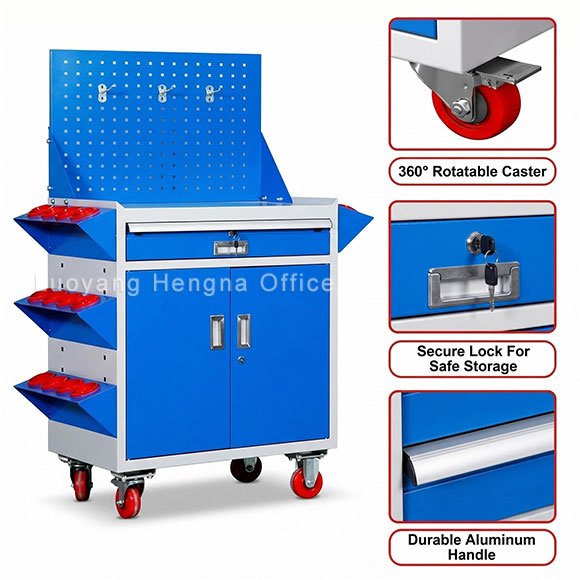
Casters decide whether it is a roller cabinet at all
A cabinet on castors is only worth having if the castors are right, and castors are the most consistently under-specified part of the whole product.
Look for a polyurethane tread on a cast iron core. The PU resists cutting oil, hydraulic fluid and most shop chemicals; the cast iron core carries the weight without deforming. A metal chip that gets into a plain bearing turns a loaded cabinet into something that will not move, and that is discovered at the worst possible moment.
Swivel on all four corners, not two fixed and two swivel. Two fixed casters mean the cabinet can only be pushed in a straight line, and a cabinet that has to be turned to reach the next bench ends up parked against a wall.
Which format suits which customer
Workshops and service bays. Roller cabinet first. It is the unit that gets moved to the job, and the tool stock lives in it.
Assembly cells. Often the reverse. A fixed bench with a shallow chest at hand height is more useful than a mobile unit when nobody moves position.
Workshops filling in over time. The roller cabinet is the base purchase and the chest is what gets added in the second budget round. This is the pattern most repeat business follows.
Tight floor plans. The stack. A chest on a cabinet gives chest-height storage without adding another footprint, and the cabinet underneath stops the chest from ending up at the wrong height. That stacked build is the configuration a workshop ends up with, so stocking both halves of it means stocking the outcome rather than a component.
What to put in the quotation
If you are supplying either format, put four numbers on the quotation rather than adjectives:
- Slide type and load rating per pair
- Coating thickness in microns, and the salt spray test it passes
- Lock type — cam, or 3-point locking rod
- Caster tread and core, and whether all four swivel
Any buyer can compare four numbers across three suppliers in a minute. Nobody can compare two adjectives, and the supplier who answers with numbers is the one that gets the follow-on order.
FAQ
Which one should a first-time buyer start with? The roller cabinet. It holds the tools and it moves with the work. The chest comes once there is a second budget round.
What slide rating do I need? 45 kg per pair is the common minimum. For drawers holding vises, die sets or large wrenches, quote 80 to 100 kg per pair.
Does full extension matter? It matters at the counter, not in the spec. Somebody reaching the back of a deep drawer without emptying the front half is the difference between a smooth job and a frustrating one.
How do I tell if a cabinet is coated properly? Ask for the coating thickness in microns. 60 to 80 microns with a 500-hour salt spray test is the standard to expect. If the supplier cannot give you the number, treat that as the answer.
Can a chest be used on its own, and do you supply both formats? A chest works on its own on a bench at working height, but not at floor level and not for heavy tooling. We supply both, separately or as a stacked build, with the four specification numbers above on the quotation.
If you are building a range rather than a single order, send us the two formats and the slide and coating specification you want to sit behind them. We will confirm what is available and quote within 24 hours.