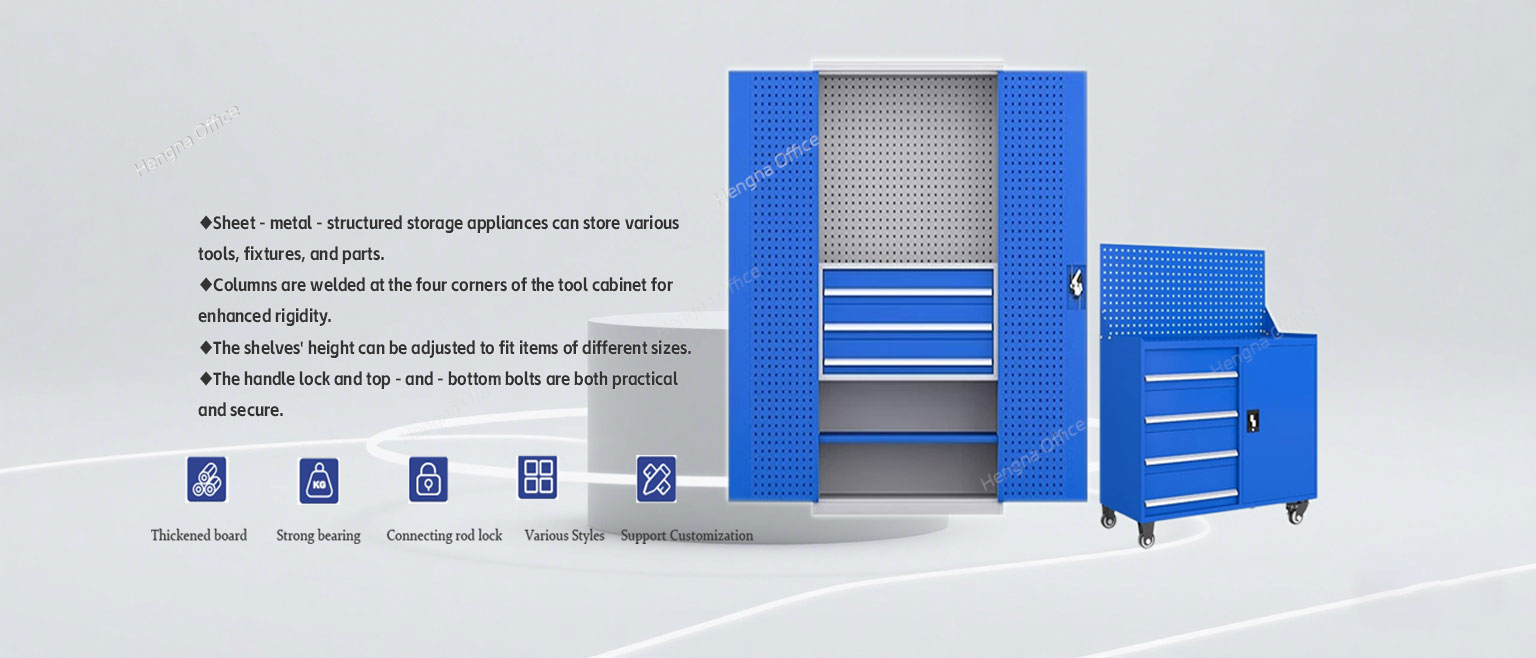
A chipped cutting edge almost never gets noticed at the spindle. It gets noticed three hours later, when the finish on a batch starts drifting and nobody can work out why. By then the scrap is made, the setup time is gone, and the operator is pulling every holder out of the cabinet trying to find the one that is damaged.
Here is the part most shops miss: the tool did not fail in the cut. It failed in storage. A BT50 holder dropped onto a steel shelf, or knocked against its neighbour when somebody reached past it, loses its edge long before it wears out.
Where tool damage actually happens
Walk into a shop with no dedicated tool storage and you will usually find three things. A drawer with holders lying loose on top of each other. A shelf where the heavy BT50 tapers are stacked because they will not fit anywhere else. And a workstation where the tool that is currently in use sits on a rag next to the machine.
None of that looks like a problem. It looks like normal work. The cost only shows up later in three places:
- Scrap parts. A chipped corner turns a run of finished parts into rework. One bad holder can take a full batch with it.
- Repeat setups. Changing a tool mid-job costs you the setup twice, not once.
- Missed dates. Re-cutting a batch pushes everything behind it along the schedule.
None of this is a tooling problem in the usual sense. It is a storage problem, and storage is much cheaper to fix than a missed delivery.
What a cutting tool cabinet has to get right
Four things, in this order.
One holder, one position. If holders share space, they touch. A slot sized for a single BT40 or BT50 holder keeps the taper clear of everything else, including the holder next to it.
No movement once it is in. A holder that can shift inside its slot will shift. The slot has to hold the holder still, not simply hold it.
Visible inventory. An operator should be able to see what is missing without opening every drawer. If a holder is out for regrinding, the empty position should be obvious from across the aisle.
Lockable and dust-tight. Tooling is one of the easiest things to walk out of a shop with, and fine dust sitting on a taper is its own slow problem. A cabinet that closes properly solves both.
That last point sounds minor until you run a stock check. If a holder is out for regrinding and the cabinet does not show it, the next operator finds out at the spindle rather than at the cabinet, and that is the expensive place to find out.
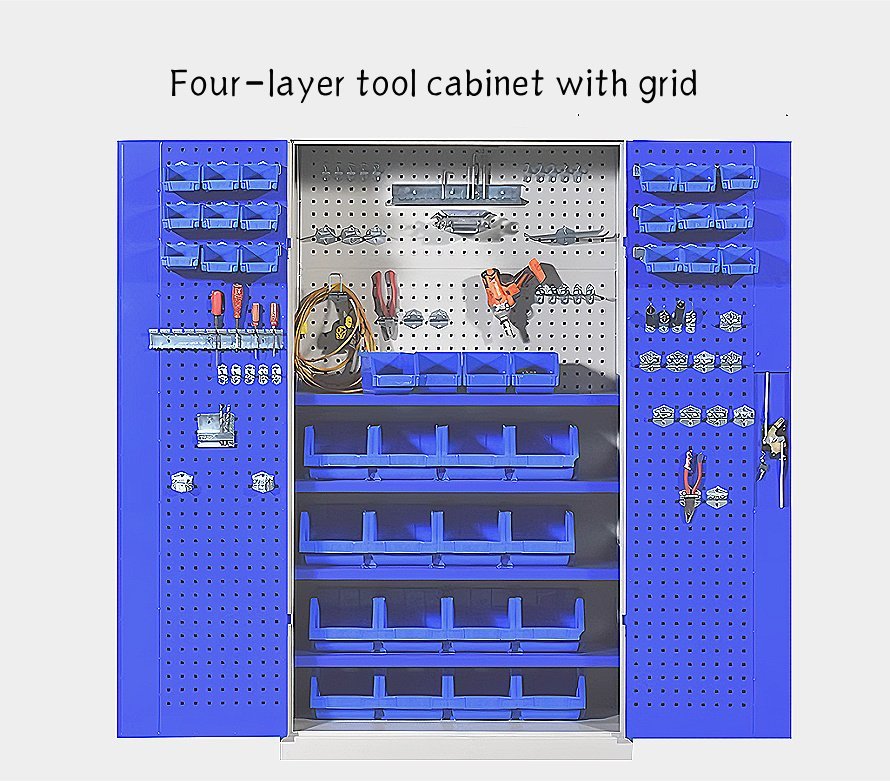
The cabinet we supply for BT40 and BT50 holders
The unit we ship for this job is a four-shelf steel cabinet with square-hole panels on the inside of the doors and on both side panels, plus ABS organiser bins that clip straight onto the grid. Holders go on the shelves, and the small parts that get lost — collets, inserts, spanner keys, pull studs — go in the bins where they are visible instead of in a drawer at the back.
| Specification | Detail |
|---|---|
| Body material | Cold-rolled steel |
| Finish | Electrostatic powder coating, blue (RAL 5015) |
| Overall size (W × D × H) | 1200 × 600 × 1800 mm |
| Shelves | 4 levels, height adjustable in 10 mm steps |
| Pegboard | Square-hole grid, 25 × 25 mm spacing, fitted to inner door and both side panels |
| Lock | Solid brass core lock, 2 keys supplied |
| Included accessories | 12 ABS organiser bins (S / M / L) plus hook kit |
| Assembly | Flat pack, roughly 30 to 60 minutes with two people |
| Packaging | Export-grade wooden crate, moisture film and corner protectors inside |
Four shelves on a cabinet this size, with 10 mm height steps, is the detail that matters more than it sounds. A BT40 holder is short; a BT50 holder is not. If the shelf spacing is fixed, one of them ends up stored badly. Adjusting in 10 mm steps means you can set one level for BT50 tapers and the next for BT40, and change it later when your tool mix changes.
The square-hole panels do the same job vertically. Holders you use every shift hang on the doors at eye level, holders you use twice a month sit on the shelves. Nothing is buried.
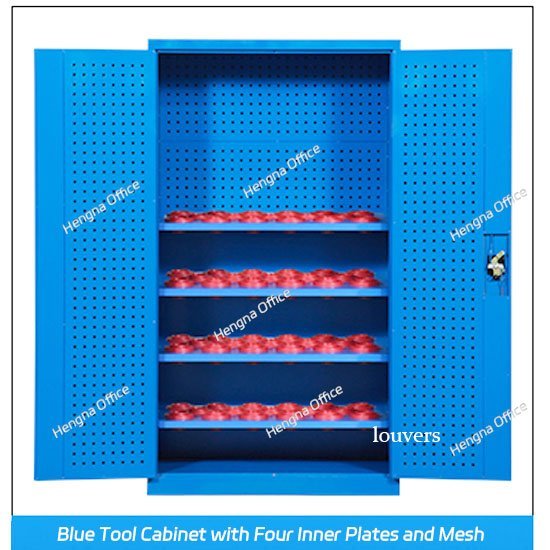
Slot layout, and why it protects the edge
The shelves take holder trays, and each tray is laid out with one position per holder. That is the whole point. When every holder has its own position, three things follow.
First, tapers never touch each other, so the edge is not damaged by a neighbour. Second, a holder that is out of the cabinet leaves a visible gap, so a missing tool is obvious at a glance rather than discovered at the spindle. Third, loading and unloading becomes a single motion — the operator does not have to pick through a pile to find the right holder.
We also build the two-door version with the trays on one side only, which suits shops where the cabinet sits against a wall or in a walkway and only one face is accessible.
Buying and export notes
Cabinets are supplied by the container. For a 1200 mm unit, a 20 ft container takes a full mixed load alongside carts, workbenches and racks, so most buyers combine products rather than shipping one line on its own. If you are working out a first order, tell us the holder mix you run — how many BT40 positions, how many BT50 — and we will confirm the shelf and tray combination before you commit.
Packing is a wooden crate with moisture film and corner protectors inside, and parts are separated rather than thrown together in one bundle. Cabinets travel flat, which keeps the crate volume down and the freight cost with it.
Custom work is normal for us: powder-coat colour matched to your range, your logo screen-printed on the panel, custom tray layouts for a non-standard taper, and manuals in your own language. If you already have drawings, send them and we will work from those.
FAQ
What is the MOQ? MOQ depends on the model and the finish. Confirmed with your quotation.
How do you quote — FOB or CIF? Both. Tell us the destination port and we will quote FOB or CIF, whichever suits your forwarder arrangements.
Warranty? One year.
After-sales? If something arrives damaged or a part is missing, send photographs of the crate and the item and we will arrange the replacement part. Damage claims are handled against the packing photographs you take on arrival, so photograph the crate before opening it.
OEM and ODM? Yes. Screen-printed logo, custom packaging, custom manuals, and custom tray or shelf layouts for your own holder range.
Lead time? Confirmed with your quotation. It depends on the model mix and the finish you ask for.
How long does assembly take? Roughly 30 to 60 minutes for two people, using the supplied fixings. No welding and no special tools.
Can it be locked? Yes. A solid brass core lock with two keys is standard, and it secures both doors.
If you are rethinking how your shop stores holders, send us the list of tapers you run and how many of each. We will come back with the shelf and tray layout that fits, and a quote within 24 hours.