A housekeeping store room is the one room in a hotel, hospital or school that nobody specifies properly. It gets whatever cabinet the installer had left over, and it gets wet every single day. Mops come in soaked, buckets get emptied into the sink, and the floor is rinsed at the end of a shift. That cabinet will be standing in standing water for most of the day, next to bottles of bleach and disinfectant, in a room with no lock on the door.
Three things follow from that, and they are worth taking in order.
Water sits where nobody drains it
Most metal storage cabinets have a flat bottom with a raised lip. Water from a mop goes to the back corner and stays there. Add the drip from a bucket and you have a shallow pool sitting under the shelf, in a warm room, for days.
That pool is where the smell comes from. It is also what slowly kills the base of the cabinet, and it is the reason the bottom shelf ends up permanently stained even when the cabinet is wiped down every week.
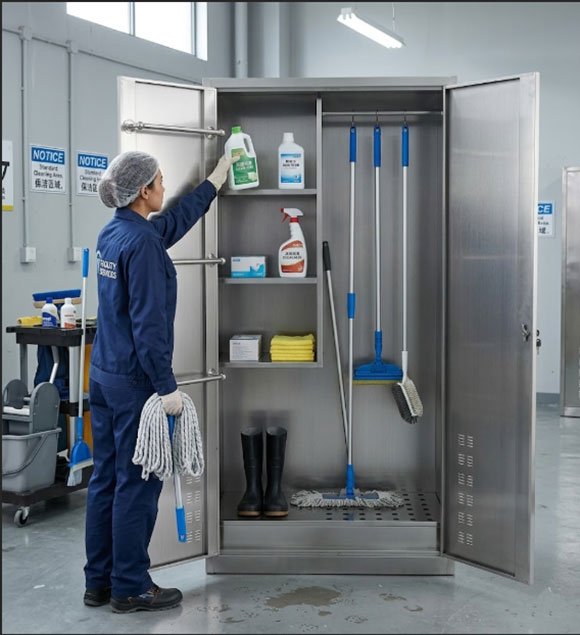
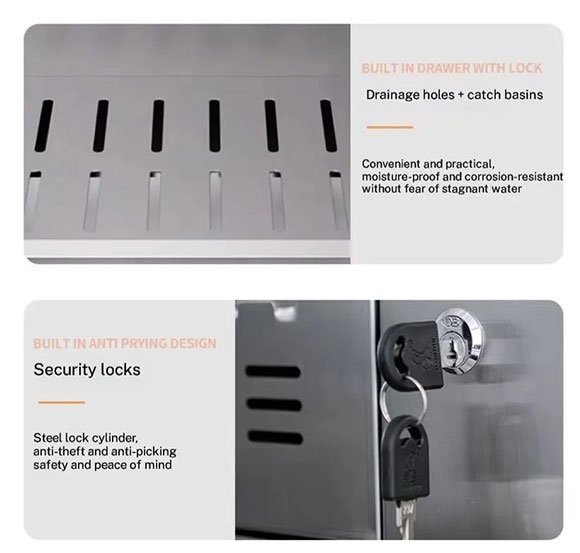
The fix is not more cleaning. It is a drain. A hole through the base, a removable tray underneath to catch what comes through, and a rod to hang wet things on so they are not sitting in the water in the first place.
Chlorine eats the cheaper grade of steel
This is the part that catches people out. A stainless steel cabinet in a janitor room is exposed to chlorine-based disinfectant several times a day, every day. The splash that dries on the door is the same stuff that is in the bucket.
That environment is what separates the two common stainless grades. 201 is what most storage cabinets are built from, and in a room with regular chlorine contact it will start to show rust marks within about six months. 304 carries 8% or more nickel, which is what gives it its resistance to acids and chlorides. In a janitor room where bleach is used daily, 304 is the correct choice and 201 is the wrong one.
Hotels and schools do not usually need 304 for chemical resistance. They need it for the same reason, though, because their cleaning rooms get the same treatment and get less attention afterwards. Switching grade costs more once. Replacing cabinets every year costs more every year.
Cleaning chemicals walk out of open rooms
A locked door is not a security detail in a housekeeping store room. It is the difference between ordering detergent on a schedule and ordering it every week.
Detergent, disinfectant, floor polish and bleach all sit in one unlocked room in most hotels, schools and gym sites. Nobody plans to steal them. They simply end up going home, and the site absorbs it as a housekeeping cost that never gets queried.
The lock on this cabinet is a steel cylinder set into the door, with an anti-pry design so it is not simply levered open with a flat screwdriver. Two keys are supplied. It is not a padlock hasp, and it does not sit on the surface where a shoe or a screwdriver gets under it.
What this cabinet is made of and how it is built
| Item | Specification |
|---|---|
| Material | 304 stainless steel, acid and alkali resistant |
| Overall size (W × D × H) | 508 × 406 × 1803 mm (with levelling feet); body height 1689 mm |
| Doors | Double door, key lock, steel cylinder, anti-pry |
| Shelf spacing, top to bottom | 300 / 381 / 351 / 99 mm |
| Drainage | Drain hole in the base plus a removable drip tray |
| Drying rod | Stainless steel bar for towels, gloves and rags |
| Tool hooks | Side panel hooks for mops, brushes and spray bottles |
The shelf spacing is worth a second look, because it is the difference between a cabinet you can load and a cabinet that wastes half its height. Four shelves at roughly 300, 380, 350 and 100 mm from the top mean the tall bottles go high, the boxes sit in the middle, and the drip tray zone at the bottom stays clear. Nothing has to sit on the base, which means nothing sits in the drained water.
The doors open the full width of the cabinet, so a mop bucket, a vacuum or a full box of chemicals can go in and come out without tipping it.
Which sites it is built for
The same cabinet gets specified into four kinds of site.
Hotels. Housekeeping closets on each floor, usually narrow and against a wall, with a door that is rarely closed because staff are in and out all day. The drain and the lock both do work here, because the closet is unmonitored.
Hospitals and clinics. The demanding case. Chlorine disinfectant is used several times a day and splashes onto surfaces, so this is where 304 stops being an upgrade and becomes the requirement.
Schools and colleges. Larger volumes of bottles, more users, and a facilities budget that pays for a cabinet once and expects it to outlast several cohorts.
Gyms and leisure clubs. Smaller rooms, high humidity, and a lot of disinfectant around wipe-down stations.
For buyers ordering in volume, the practical unit is how many closets you have, not how many cabinets. Tell us the site count and the door width of the opening, and we will confirm the quantity and the packing plan with the quotation.
Ordering and export
These cabinets ship in reinforced crating, with moisture-proof wrap and corner protectors inside so the doors and the drip tray do not get marked in transit. Damage claims are assessed against photographs of the crate, so photograph it before opening.
For buyers running several sites, consolidation beats shipping one site at a time. Ten units for one hospital and twelve for another can share a single 20-foot container, which on typical sea freight rates cuts the per-unit cost by around 40% against two separate shipments. Send us the site list and we will work out the loading plan with the quotation.
Custom work is routine for us. Powder-coat finish matched to your standard, your logo screen-printed on the door, different shelf spacing, and documentation in your own language. If you need units to fit an existing recess, send the opening dimensions and we will build to them.
FAQ
What is the difference between 304 and 201? Nickel content. 304 carries 8% or more and resists acids and chlorides; 201 has less and will show rust in a room where bleach is used daily. In a dry store, 201 is fine. In a janitor room, use 304.
How does the water actually drain? Through a hole in the base into a removable tray underneath. Pull the tray out, empty it, rinse it, slide it back. There is no pump and no plumbing connection.
Is it lockable? Yes. A steel cylinder lock with an anti-pry design secures both doors, and two keys are supplied.
Will it fit a narrow closet? The unit is 406 mm deep and 508 mm wide. Give us the opening width and depth and we will confirm the clearance you need to open the doors and pull the tray out.
What is the MOQ? Depends on model and finish, confirmed with your quotation.
How do you quote — FOB or CIF? Either. Send the destination port and we will quote whichever suits your forwarder arrangements.
Warranty? One year.
After-sales? If something arrives damaged or a part is missing, send photographs of the crate and the item and we will arrange the replacement. Photograph the crate before opening it, since damage claims are assessed against those pictures.
OEM and ODM? Yes. Screen-printed logo, custom finish, custom shelf spacing, custom packaging and manuals in your own language.
Lead time? Confirmed with your quotation, depending on the model mix and the finish.
If you are replacing cabinets across a site, send us the number of closets and whether the existing ones are 201 or 304. We will come back with a quantity, a packing plan and a quote within 24 hours.