Buying a material rack comes down to three numbers: how much each shelf takes, how deep it is, and how many tiers you can actually reach. Get one wrong and the rack gets replaced within a year, usually with the same mistake repeated at a different depth.
Load: what 150kg per shelf actually covers
A 150kg rating is a uniformly distributed load. That means a box of bolts spread across the shelf, not a 150kg motor sitting on one corner. The same rating logic is explained in our note on three-tier steel shelving loads.
The difference matters. Put a point load in the middle of a shelf and the beam deflects where the weight sits. Put it over an upright and the same shelf carries it without visible movement. If your stock arrives as heavy single items rather than cartons, ask for the point load figure, not the headline.
One more thing worth asking: whether 150kg applies to every shelf or to a total spread across the rack. A rack rated 300kg across three shelves is not the same as three shelves rated 150kg each, and the weaker reading is the one that decides what you can store.

Depth: the only number that changes your aisle
Depth is where most material rack plans go wrong, because it is the number that looks free. It is not. Every extra 100mm of rack depth comes straight out of the aisle.
Take a 1200mm aisle. A 900mm deep rack leaves 300mm — not enough to walk with anything in your hands, and not enough for a pallet truck. A 600mm rack leaves 600mm, which works. A 450mm rack leaves 750mm, which is comfortable.
- 450mm — bins, small parts, shallow cartons. The aisle stays generous.
- 600mm — the working depth for most workshops. Boxed stock and bins together.
- 900mm — deep stock, long items, or a room with aisles to spare.
If the volume is not there at 600mm, go up rather than out. Height costs nothing in floor space; depth costs the aisle. Where the stock is bins rather than cartons, a double-sided pegboard and bin rack gives two faces in the same footprint.
Tiers: why three beats four in most store rooms
A fourth tier sounds like free capacity. In practice, anything above eye level gets used once and then becomes storage for things nobody wants to decide about.
Three tiers at adjustable heights put everything between knee and shoulder — the range where people actually reach. Set the bottom tier for heavy stock, the middle for daily picks, and the top for the slow-moving items that still need to be off the floor.
If you need more capacity than three tiers give, the answer is usually a second material rack rather than a taller one. Two racks also give you a second aisle face, which a taller rack does not.
HN-MR03 specifications
| Item | Detail |
|---|---|
| Model | HN-MR03 |
| Tiers | 3, adjustable height |
| Shelf load | 150kg per shelf, uniformly distributed |
| Depth | 960mm |
| Body | Reinforced cold-rolled steel, powder coated |
| Feet | Levelling feet, optional castors |
| Finish | Blue standard, other colours to order |
| Assembly | Knocked down, bolted frame |
960mm is the deep end of the working range, which suits boxed stock and long cartons. If your aisle is under 1400mm, take the 600mm version instead — a rack that blocks the walkway stops being loaded properly within a month, and the stock migrates to the floor.
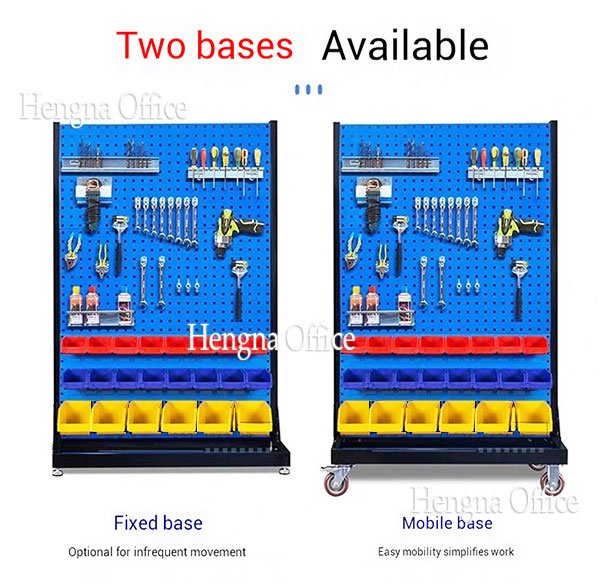
Fixed or mobile
A fixed rack holds more per square metre, because it does not need clearance around it and it can be bolted to the floor. A mobile material rack trades a little capacity for the ability to follow the work.
Buy mobile when the stock moves between the store and a line-side position during the shift — the three-tier rack with optional wheels covers that case. Buy fixed when the rack is the store, and the people come to it. Buying mobile for a rack that never moves is paying for castors that will flat-spot in place.
If you are not sure, look at how often the position changes in a week. Less than once, go fixed. Every shift, go mobile and check the castor rating against the load — a 150kg shelf fully loaded puts real weight on four small wheels.
How many racks for a store room
Count the shelf faces you need, not the square metres. Each rack gives you three faces; a double-sided unit gives six. Then work out how much of each face is taken by a single SKU.
A store room running 200 fasteners and fittings typically needs four to six single-sided material racks, with the fastest-moving lines closest to the door. The number that decides it is not total volume, it is how many distinct items need their own visible position.
If two SKUs share a bin, they will be mixed within a week. That is not a discipline problem, it is a layout problem, and it is solved by adding faces rather than by asking people to be tidier. For a line-side position that needs colour coding, the two-sided kanban rack with bins is built for that job.
What to check before you order
- Per-shelf rating, and whether it is uniform or point load.
- Depth against your real aisle — measure it, do not estimate it.
- Shelf adjustment range — big steps will not give you the bay heights you need.
- Feet or castors — levelling feet on a sloped floor, castors only if the rack genuinely moves.
- Whether bins are included — some racks ship bare, and that changes the price comparison.
Packing and loading
Racks ship knocked down. Uprights and beams travel in moisture film, corner protectors go on the ends, and hardware is bagged and labelled. Instructions ride in the same carton.
Knocked-down packing keeps the freight volume down, which matters on a container order: a bolted rack frame packed flat takes a fraction of the space of an assembled one. For distributor orders, tell us the pallet plan and we pack to it.
FAQ
What is the minimum order quantity?
MOQ depends on colour and whether bins are included. Tell us the quantity and we confirm what works.
How do I get a quote?
Send the depth, tier count, quantity and destination port. We reply within 24 hours.
Can I get the 600mm depth instead of 960mm?
Yes. Tell us the aisle width and we will say which depth leaves a workable walkway.
Are the shelves adjustable?
Yes, in fixed increments up the upright. Tell us the tallest item you store and we set the positions before dispatch.
Can I add a fourth tier later?
Yes, if the uprights are ordered for it. Confirm at order time, because the upright height has to be specified up front.
Do you supply bins with the rack?
Bins can be supplied with the rack or separately. Send the bin size you use and we match the shelf spacing to it.
Do you offer OEM and ODM?
Yes. Silk-screen logo, custom carton printing and a custom manual are all possible.
What is the lead time?
Lead time depends on quantity, depth and whether bins are included. We confirm the schedule when the order is placed.
How is the rack packed?
Knocked down, uprights and beams in moisture film, corner protectors, hardware bagged and labelled.
The short version
A heavy-duty material rack is bought on three numbers, so check all three before the order goes out. Confirm the shelf rating is uniform and applies to every tier, measure the aisle before choosing 960mm, and keep the working tiers within reach. The rack that gets loaded properly for ten years is the one that fits the room, not the one with the highest headline figure.
Send the depth, tier count, quantity and port, and we come back with a quote within 24 hours.