A deposit is the easiest money you will ever send, and the most expensive one to send badly.
By the time a tool cabinet reaches your customer’s workshop and the drawers start binding, the container has been paid for, the deposit is gone, and the conversation you have with your supplier is about replacement parts rather than about quality. Every one of the seven checks below costs nothing but a question, and every one of them is answerable before you wire anything.
1. The drawer slides, and the number behind them
Ask two questions: what type of slide, and what load rating per pair.
Friction slides are two pieces of steel rubbing against each other. They are acceptable in an empty cabinet and unacceptable the moment somebody puts 20 kg of sockets in the drawer. The slide type you want specified is ball bearing, full extension.
The load rating is the number that matters. 45 kg per pair is the common minimum. If the drawer will hold steel tooling — vises, die sets, large wrenches — the figure to insist on is 80 to 100 kg per pair. Full extension matters just as much as the rating, because it is what lets someone reach the back of a deep drawer without emptying the front half first.
If a supplier cannot quote a per-pair rating, they are selling a slide, not specifying a product.
2. The coating, in microns
Ask for the coating thickness in microns and the salt spray test it passes. Workshop cabinets should be 60 to 80 microns with a 500-hour salt spray test. Budget cabinets commonly ship at 30 to 40 microns, which look identical out of the container and show rust at the edges and weld points within about eighteen months.
Coating is the cheapest part of the cabinet and the first thing to fail. It is also the easiest thing for a supplier to lie about, because nobody opens a cabinet to check it on delivery. If a supplier cannot give you the micron figure, that is your answer.
3. Hinges and the locking system
Cabinet doors are opened a hundred times a day, so hinges should be welded to the frame, not screwed. Vibration from nearby presses and spindles works screws loose, and individual hinges create stress points that eventually oval out. A continuous piano hinge distributes the door weight along the whole frame edge.
On the lock, ask whether it is a single-point cam or a 3-point locking rod that engages the frame at the top, middle and bottom. The rod version wins on a cabinet that is loaded unevenly, because a single point lets the door twist. Look for a solid core lock rather than a thin stamped one, and confirm how many keys come with it.
4. The casters, because this is a mobile product
A cabinet on castors is only worth having if the castors are specified, and castors are the most consistently under-specified part of the whole product.
Ask for polyurethane tread on a cast iron core. The PU resists cutting oil, hydraulic fluid and most shop chemicals; the cast iron carries the load without deforming. A plain bearing takes a metal chip and turns a loaded cabinet into something that will not move — discovered at exactly the wrong moment.
Second question: are all four casters swivel? Two fixed and two swivel means the cabinet can only be pushed in a straight line, and a cabinet that has to be turned to reach the next bench ends up parked against a wall.
5. The drawer bottom
This is the detail nobody asks about and everybody notices when it is wrong. Look for a double-folded edge on the drawer bottom rather than a single fold closed with one spot weld.
The fold adds roughly 40% more rigidity without adding weight. A single-weld bottom bows under a heavy vice, and once it bows it jams the drawer below it. That turns one cheap component into a cabinet that comes back to you.
6. Packing, and what it does to your landed cost
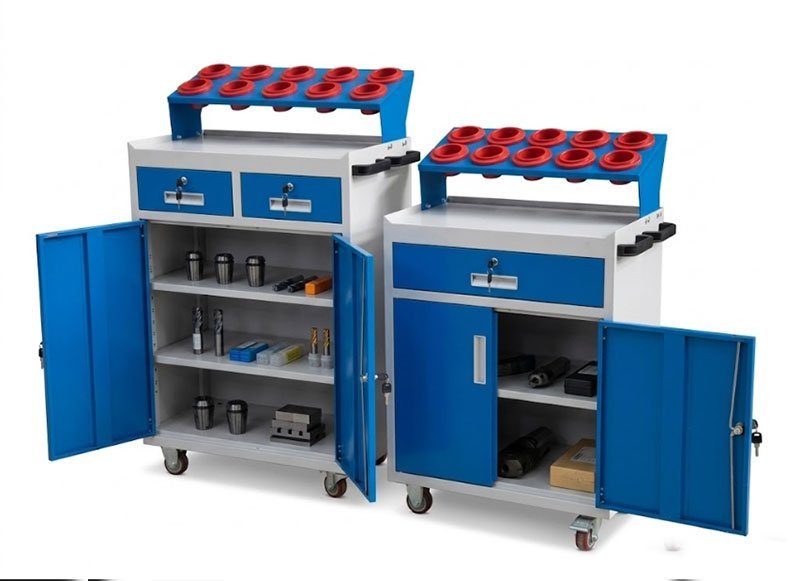
Tool cabinets ship flat-packed. Ask exactly what the packing consists of, because this is where the freight cost is decided.
The specification to look for: reinforced cartons, steel components separated with a moisture barrier film and corner protectors, the slide mechanisms foam-wrapped so they cannot rattle against the frame in transit, and the cartons strapped to a wooden pallet for container loading. Some models ship in a wooden crate instead, which is worth paying for when the route is long or the goods are insured.
Then look at consolidation. Ten units going to one site and twelve to another can share a single 20-foot container, and on typical sea freight that cuts the per-unit cost by around 40% against two separate shipments. Ask for the loading plan with the quotation rather than assuming it is being done.
7. Spare parts, and what happens after the warranty
Ask what the supplier still carries once the warranty has expired. The answer should be the wear parts: replacement slides, lock cores, casters.
On these products the warranty is one year on the frame and worktop under normal use, and what a supplier can still send you two years later tells you whether they are a supplier or a one-off trader. A cabinet that can be kept going is a cabinet that does not get replaced, and a customer who does not replace is a customer who orders again.
The seven questions, as a list you can send
If you want to forward this to a supplier, this is the whole thing:
- Slide type, and load rating per pair
- Coating thickness in microns, and the salt spray test passed
- Hinges welded or screwed, and single-point cam or 3-point locking rod
- Caster tread material, core material, and whether all four swivel
- Drawer bottom: single fold with one weld, or double-folded edge
- Packing specification, and the container loading plan
- Wear parts still supplied after the warranty period
Three commercial answers to get in the same email
Specifications tell you whether the cabinet will last. Three commercial answers tell you whether the deal will close:
MOQ, and whether it applies per model or per order. Incoterms — FOB or CIF, against a named destination port, not a general one. Lead time, confirmed rather than estimated, and tied to the finish you have specified rather than the standard one.
On top of those, ask what customisation is available without a new tool: screen-printed logo, colour matched to your range, custom packaging, and documentation in your own language. If your volume justifies it, ask for the coating and hardware specification in writing before the deposit, not after.
FAQ
What is the single most important spec on this list? The coating thickness, because it is the cheapest part of the cabinet and the first thing to fail, and because it is the easiest number for a supplier to avoid giving you.
What load rating do I need? 45 kg per pair is the common minimum for general tool storage. For vises, die sets and large wrenches, quote 80 to 100 kg per pair.
Does it matter that the cabinet is flat-packed? It reduces freight cost and it is standard for this product. What matters is the packing detail — moisture barrier film, corner protectors, foam-wrapped slides and a pallet.
How do I check a supplier’s claims before paying? Ask for the coating microns and the slide load rating per pair. Both are specific, both are verifiable, and a supplier who answers both is one you can send a repeat order to.
What about documentation? Manuals and packing lists in your own language can be specified as an OEM item alongside your logo and your packaging.
What is the MOQ and the lead time? Both depend on the model and the finish, and both are confirmed with the quotation rather than quoted from a list.
Do you supply to FOB or CIF? Either. Send the destination port and we will quote against it, with the loading plan included.
Warranty? One year on the frame and worktop under normal use, and we continue to supply replacement slides, lock cores and casters afterwards.
Send us the seven answers you get from your current supplier and we will put ours against them, line by line, with a quotation within 24 hours.