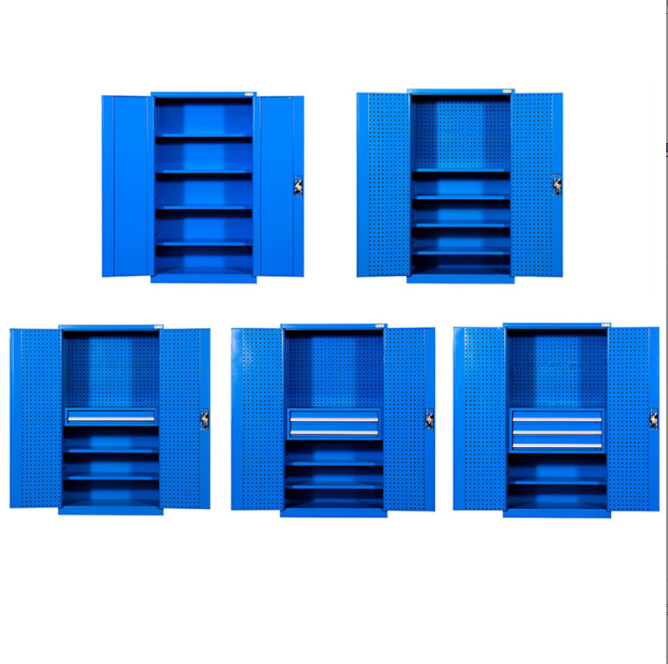
In a factory, your tool cabinet takes a beating every shift. Forklifts bump it. Heavy die sets get dropped on it. Coolant mist settles on every surface. Pick the wrong cabinet, and within six months your drawers jam, doors stop closing square, and the powder coat starts peeling in sheets. This article walks through the five things that fail first on cheap cabinets — and what to look for so yours doesn’t.
1. The Steel Gauge — Don’t Buy What You Can Bend with Your Thumb
Cold-rolled steel is the baseline for any factory cabinet. It starts as hot-rolled coil, gets pickled in acid to remove mill scale, then run through rollers at room temperature. The cold rolling tightens the grain structure — the same 1.2mm panel ends up about 20% stiffer than hot-rolled of identical thickness.
Here’s where manufacturers cut corners: they drop to 0.6mm or 0.8mm steel for body panels. On a spec sheet nobody notices. In a shop, you notice fast. Push on the door panel with your thumb. If it flexes, walk away. Factory-grade cabinets start at 1.0mm for body panels and 1.2mm for doors and drawer fronts. Under 0.8mm, the frame racks when pushed and the door stops closing square within a year. Our heavy-duty tool cabinet vs. tool chest breakdown shows the steel thickness is usually what separates the two price points.
For wet environments — food plants, chemical storage, outdoor tool cribs — step up to galvanized steel. Hot-dip galvanizing deposits a zinc layer 50-85 microns thick. Zinc corrodes sacrificially: it oxidizes first, protecting the steel underneath. In a coastal warehouse or a factory with daily wash-downs, galvanized cabinets outlast powder-coated ones by 3-5 years.
2. Drawer Slides — The One Part You’ll Replace If You Get It Wrong
Drawer slides are the single biggest failure point. Budget cabinets use friction slides — two pieces of steel rubbing against each other. They work fine when the cabinet is empty. Load a drawer with 20 kg of sockets, and suddenly you’re kicking it shut with your boot.
Ball-bearing slides rated for 45 kg per pair is the minimum. If your drawers hold steel tooling — vises, die sets, large wrenches — you want 80-100 kg per pair. Full-extension slides let you reach the socket at the back without emptying the front half first. Self-closing slides add convenience but are one more mechanism that can fail.
One more detail: the drawer bottom. Some manufacturers use 0.5mm steel with a single spot weld. Drop a 15 kg vise in there and the bottom bows, jamming the drawer below it. Look for double-folded edges on the drawer bottom — a small detail that adds 40% more rigidity without increasing weight. Same principle you’d want in a parts bin cabinets vs. drawer systems setup.
3. Powder Coating — 60 Microns vs. 30 Microns Is the Difference Between Rust and No Rust
Raw steel rusts. In a factory with humidity swings, coolant mist, and wash-down areas, bare steel develops surface rust within weeks. Powder coating is the standard finish — polyester powder electrostatically sprayed and baked at 180-200°C. It bonds to the steel at a molecular level, creating a shell that flexes with the metal instead of cracking like wet paint.
The number that matters: coating thickness. 60-80 microns is standard for industrial cabinets and passes a 500-hour salt spray test. Budget cabinets often ship with 30-40 micron coatings — looks fine out of the box, but within 18 months you’ll see rust blooming at edges and weld points. Ask the supplier for the coating spec. If they can’t tell you the micron number, they’re probably hiding it. The same finishing quality check applies to how to stop rust and mold in janitor closets — moisture protection starts with the coating.
4. The Door Hinges and Locking Bar — What You Open a Hundred Times a Day
Cabinet doors are the most-used moving part on any tool cabinet. Hinges should be welded to the frame, not screwed. Screws loosen with vibration from nearby stamping presses or CNC spindles. A continuous piano hinge distributes the door’s weight along the entire frame edge. Individual hinges — even three of them — create stress points that eventually oval out the screw holes.
A 3-point locking rod system beats a single-point cam lock every time. The steel rod runs the full height of the door, engaging the frame at top, middle, and bottom. This matters most when the cabinet is loaded unevenly and the door wants to twist. If you stock anything a worker could hurt themselves with — or anything expensive enough to walk away — locking is non-negotiable.
5. Casters — The Rating That Matters More Than the Price Tag
A cabinet on wheels goes where the work is. But casters are consistently under-spec’d. You see “heavy-duty casters” on the listing and assume they’re adequate. Then six months in, a metal chip wedges in a bearing and your 200 kg cabinet becomes a 200 kg immovable object.
Polyurethane tread on a cast iron core is the gold standard. PU resists cutting oil, hydraulic fluid, and most shop chemicals. Cast iron handles weight without deforming. Swivel casters on all four corners give you maximum maneuverability — two fixed and two swivel limit you to straight-line pushing. Total caster load rating should be at least 1.5× the cabinet’s fully loaded weight. Locking casters should lock both the wheel and the swivel. A wheel-only lock means the cabinet can still pivot when you’re torquing against it.
One more trick that saves headaches: load the bottom drawers with the heaviest items — tool steel, large fixtures, die sets. This keeps the center of gravity low. An 1800mm tall cabinet with heavy tools in the top drawers is a tipping hazard waiting to happen.
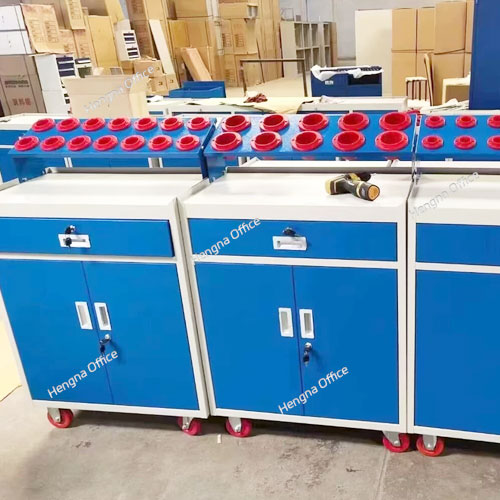
Cold-rolled steel factory tool cabinet with 5-drawer layout. Door panels are 1.2mm steel with 60-micron powder coating — the minimum for a production environment.