Why a Mobile Tool Cabinet Changes How Your Shop Floor Works
Every shop has a tool problem, but not every shop has the same one. A small engine repair bay needs tools at the lift, not at a central crib. A CNC job shop needs cutting tool holders organized by machine. A factory maintenance team needs to roll a full set of wrenches and meters to whatever line is down. A mobile tool cabinet with drawers solves all three — but only if you pick the right one for your actual workflow.
Wheels: The Part That Moves or Breaks
Casters are the most under-spec’d component on any mobile cabinet. You see “heavy-duty casters” on the listing and figure they’ll work. Then six months in, a wheel seizes because a metal chip wedged in the bearing, and your 200 kg cabinet becomes a 200 kg immovable object.
Polyurethane tread on a cast iron core is the gold standard. PU resists cutting oil, hydraulic fluid, and most shop chemicals. Cast iron handles the weight without deforming. Swivel casters go on all four corners for maximum maneuverability — two fixed and two swivel limit you to pushing in a straight line. Total caster load rating should be at least 1.5× the cabinet’s fully loaded weight.
Locking casters: get the kind that locks both the wheel and the swivel. A wheel-only lock lets the cabinet still pivot in place. A total-lock caster freezes both axes, which matters when you’re torquing a bolt and the cabinet wants to drift away from you. For more on what a well-built tool cabinet should handle, see our rolling tool cabinet for auto repair shops breakdown.
Drawers: How Many, What Size, and What They Hold
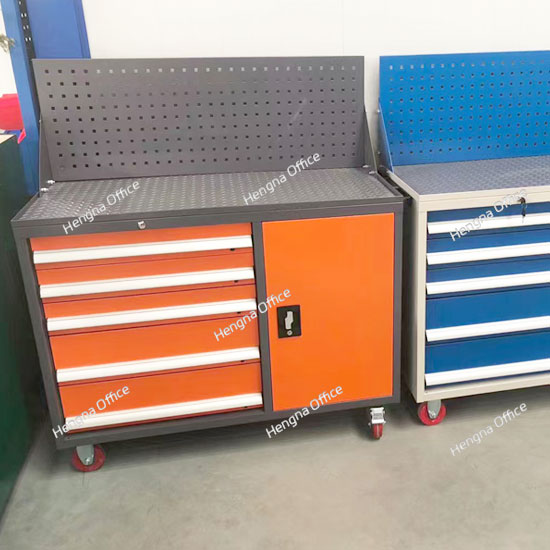
Drawer configuration determines how useful the cabinet actually is. Common layouts:
- All shallow (50-75mm high): Good for sockets, wrenches, measuring tools, small parts. Useless for power tools. Common in mechanic carts.
- Mixed depth (2-3 shallow + 2-3 deep at 100-150mm): Most versatile. Shallow for hand tools; deep for drills, grinders, diagnostic gear.
- Full-height cabinet (300mm+ compartments): For bulk storage of consumables, PPE, cleaning supplies. Works best as part of a modular system alongside drawer cabinets.
Drawer slides are where corners get cut. Check the rating — 45 kg per pair is minimum acceptable. 80-100 kg per pair is what you want if drawers hold steel tooling. Ball-bearing slides with a catch at full extension stop the drawer from sliding all the way out. Self-closing slides cost more and are one more mechanism that can fail.
Steel Thickness and Frame Construction
A mobile cabinet gets pushed, pulled, bumped, and leaned on daily. The body panels should be at least 0.8mm cold-rolled steel. Drawer fronts and the top tray: 1.0-1.2mm. The frame — the skeleton underneath — should be rectangular tube or formed channel, not just folded sheet metal. A welded box-section frame keeps the cabinet square when one caster hits a floor crack while three are on smooth concrete.
Powder coating is standard. The thickness matters — 60-80 microns gives you scratch resistance. Thinner coatings (30-40 microns) are cheaper but show rust spots within a year in humid shops. The color serves a practical purpose in multi-shift operations: blue cabinets for one shift, grey for another, red for shared tooling. Same durability logic applies to steel tool locker for construction sites used on construction sites.
Top Tray and Open Storage — What Goes Above the Drawers
Many mobile cabinets have a top compartment with a lid or an open tray. An open top tray is more practical than a lid for daily use — you can toss frequently used tools, spray bottles, and setup sheets in without opening anything. Some trays come with a ribbed rubber mat that keeps items from sliding when the cabinet moves. A lipped edge (15-20mm high) around the tray perimeter prevents tools from vibrating off.
Side panels can carry pegboard, tool hooks, or a small aerosol can holder. These turn the cabinet from a box on wheels into a mobile workstation. In a shop where the alternative is walking 30 meters to a fixed tool board, having pegboard on the cabinet saves 5-10 minutes per job.
Locking: Central Lock vs. Individual Drawer Locks
Most cabinets use a central locking system — one key locks all drawers through a vertical bar. Convenient, but it’s a single point of failure. If the locking bar mechanism jams from accumulated dust and metal chips, you can’t open anything.
Individual drawer locks give more granularity — you can lock the drawer with expensive measuring tools while leaving the consumables drawer accessible. But they’re less common on mobile cabinets and add cost. A practical compromise: central lock for general security, plus a separate lockable compartment for high-value items like torque wrenches and digital calipers.
When a Mobile Cabinet Makes Sense
- Your techs bounce between bays or machines all shift — they need tools at the work, not at a central crib
- You run two or three shifts sharing one set of tools. Roll the cabinet to the active bay, lock it when the shift ends
- Floor space is under 40 square meters — fixed cabinets eat aisles, mobile ones tuck against the wall
- Your team does line-side repairs where the machine can’t come to the tools
Skip the Mobile Cabinet When
- Every job happens at the same bench, same spot, every day — wheels are just an expensive way to make the cabinet wobble
- Your tools are heavy single items (20+ kg each) forklifted into place, not carried by hand
- The floor is cracked, unpaved, or has expansion joints every few meters — casters won’t roll, they’ll trip
- The cabinet’s real job is a locked tool crib only the shift supervisor opens — save the $80-120 caster budget