When you’re budgeting for a heavy-duty workbench, the price isn’t random — it follows a pattern driven by three things: what the top is made of, how big it is, and what extras come built in. This article breaks down real price ranges based on actual OEM factory rates from Luoyang industrial furniture manufacturers, not retail markup. Before you buy, also check what steel thickness for workbench tops to understand how top thickness affects your choice.
The Material Drives the Price More Than Anything Else
A workbench is three things: a frame, a top, and legs. The frame is almost always cold-rolled rectangular steel tube — 50×50mm or 60×40mm, 1.5-2.0mm wall thickness. Frame cost difference between entry-level and industrial-grade is maybe 15-20%. The real cost driver is the worktop.
Entry-level top: 20-30mm MDF with laminate. Fine for light assembly, electronics repair, packing stations. Won’t survive a hammer blow or oil exposure. A 1500×750mm bench with this top, steel frame, no drawers: roughly $100-180 USD ex-factory.
Mid-range top: 30-40mm high-density particleboard with 2mm HPL (high-pressure laminate). Resists scratches, handles occasional oil contact, wipes clean. Good for general mechanical work, small engine repair, QC stations. 1500×750mm with one drawer unit: roughly $200-350 USD.
Heavy-use top: 8-15mm solid steel plate. This is what you need if anyone swings a hammer on it. A 10mm steel top on a 2000×750mm bench weighs about 120 kg — just the top. It won’t warp, won’t dent from dropped vises, and you can tack-weld fixtures to it. Price jumps sharply: $400-700 USD. The steel plate alone, at current Chinese mill prices, runs about $100-150 USD for a 2000×750×10mm piece before fabrication.
Specialty tops: 304 stainless steel for food/pharma GMP environments adds 50-80% over the steel plate price. ESD laminate tops for electronics assembly sit in mid-range but need grounding hardware. Butcher block hardwood tops — uncommon in B2B but requested for certain lab benches — fluctuate with timber prices.
Size Follows a Step Function, Not a Smooth Curve
Workbench dimensions cluster around standard sizes because steel tube and sheet come in standard mill dimensions (1220×2440mm or 1500×3000mm). This creates natural breakpoints:
- Compact (1200×600mm to 1500×750mm): Single-person stations. Uses one standard sheet with minimal waste. Most affordable.
- Standard (1800×750mm to 2000×800mm): Two-person or spread-out single user. Sweet spot for auto repair, fab, maintenance shops.
- Large (2400×900mm to 3000×1000mm): Big fab tables, inspection layouts, assembly lines. Price jumps because the top needs to be a single continuous sheet — joining two plates creates a seam that catches parts and fluids.
Custom dimensions cost more than you’d think — not because materials cost more, but because cutting non-standard sizes from standard sheets creates waste. A 2200×850mm bench might generate 30% material waste vs. a 2000×800mm from the same sheet.
Drawers, Pegboards, and Power — What Each Add-on Costs
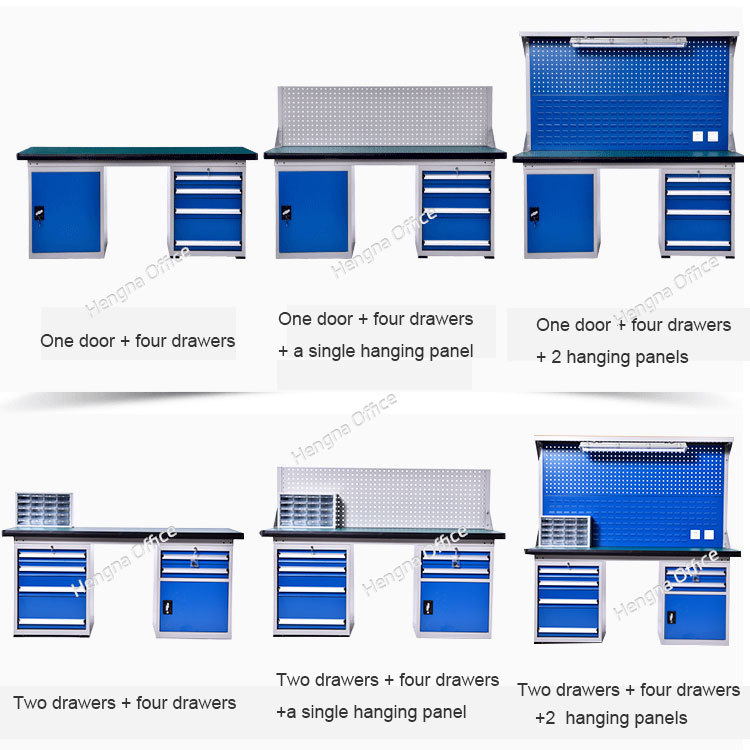
- Undermount drawer unit (1-2 drawers): +$50-100. The slides are most of it — good ball-bearing slides cost $8-15 per pair at factory volume.
- Multi-drawer pedestal (3-5 drawers): +$120-250. More drawers = more steel, more labor, more slides.
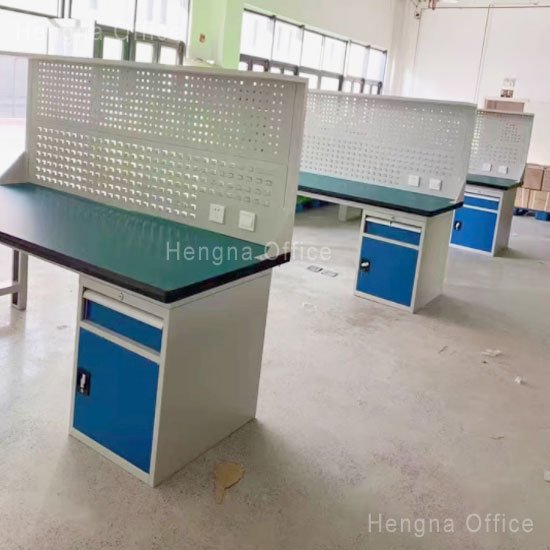
- Pegboard back panel (full width, 600-900mm high): +$30-60. The pegboard itself is cheap; the steel frame to support it is not.
- Upper shelf/overhead cabinet: +$80-180.
- LED task light (integrated, wired): +$25-50.
- ESD grounding system: +$40-80. Grounding stud, wrist strap connectors, conductive top — all verified with a megohmmeter.
Real Price Ranges — FOB Luoyang, Wholesale Quantity
| Configuration | Top Material | Size | FOB Range |
|---|---|---|---|
| Basic assembly bench | MDF/laminate | 1500×750mm | $100-180 |
| Standard bench + 2 drawers | HPL composite | 1800×750mm | $220-350 |
| Heavy fab table + 3 drawers + pegboard | 10mm steel plate | 2000×750mm | $450-650 |
| Stainless GMP bench + shelf | 2mm 304 SS over ply | 1800×750mm | $550-800 |
| Full ESD workstation + light + power | ESD laminate | 1800×900mm | $350-550 |
| Custom large fab table | 12-15mm steel | 3000×1000mm | $700-1,200 |
These are ex-factory prices. Ocean freight to US West Coast adds roughly $80-150 per bench depending on volume. To Europe, $100-200. Import duties vary by country — workbenches typically fall under HS code 9403.10 or 9403.20.
The biggest money-saver: buy bench + tool cabinet from the same factory. Combined shipping saves 30-50% on freight per unit. And matching sets are easier to resell — they look like a complete solution, not random furniture. For ideas on what configurations work best, see our 6 modular workbench configurations guide.
Landed Cost: What the Factory Price Doesn’t Include
FOB means the bench is loaded onto the ship at the port — after that, the cost is yours. Here’s what gets added between Luoyang and your warehouse:
- Ocean freight: $80-150 per bench to US West Coast, $100-200 to Europe, depending on container utilization. A 20ft container holds about 40-50 assembled benches or 100+ flat-packed.
- Customs bond and clearance: $50-125 per shipment, not per unit. If you’re importing 10 benches, this adds $5-12 per unit.
- Import duty: varies by country. US: typically 0% on metal office/factory furniture under HS 9403.10. EU: 0-5.6% depending on country of origin classification. Always confirm with your customs broker.
- Inland trucking: from port to your warehouse. Budget $200-600 for LTL freight depending on distance from port.
- Warehouse receiving: $25-50 per pallet for unloading and inspection.
Rule of thumb: landed cost is roughly 1.3-1.6× FOB price for US buyers, 1.4-1.8× for European buyers. A $300 bench leaves the factory at $300 and lands in Chicago at about $420-480. Still well below the $800-1,200 a comparable US-made bench retails for.
Factory vs. Retail: Where the Margin Goes
A $300 FOB bench becomes an $899 retail bench through a chain of markups: importer/distributor adds 40-60%, regional wholesaler adds 25-35%, end retailer adds 40-50%. Each link also adds warehousing, warranty liability, and marketing cost.
If you’re buying 10+ benches for your own facility, or if you’re a distributor importing container loads, skip the chain and go factory-direct. You’ll pay FOB + freight + duty and save 40-60% versus buying from a domestic wholesaler. The trade-off: you handle quality inspection and warranty claims yourself. For a first order, ask the factory to send a production sample — it costs $80-150 in air freight but saves you from discovering a spec mismatch after a full container arrives.