Here’s what a busy season looks like in an auto repair shop. Every bay is full. Cars sit on lifts, parts pile up on the floor, and your mechanics move between the underside, the hood, and the wheel wells. One bay runs three or four cars a day. The rolling tool cabinet gets pushed back and forth dozens of times. By the end of the season, that cabinet has traveled more miles than your shop truck.
That’s when you find out which cabinets are decoration and which ones are built to work.
Wheels seize up. Drawer slides get so stiff you kick them shut. Doors warp and stop closing. None of that shows in the slow season. It all shows when things get busy. And when the cabinet dies, your mechanic walks across the shop to the fixed toolbox every time he needs a wrench. Thirty seconds per trip. Half an hour gone by the end of the day.
Honestly? Most budget tool carts were never designed for this kind of use. They were built to look good in a photo, not to survive a working shop.
The Busy Season Is a Reality Check — Four Things That Fail First
After years in this business and a lot of conversations with shop owners, the failure points are always the same.
Wheels. The cheap ones use nylon or thin rubber. Two months in, they start shedding material and rolling with a click-clack. Shop floors aren’t office floors. There’s oil, metal filings, weld slag. If the wheel isn’t hard enough and the bearing isn’t good enough, it won’t last one busy season.
Drawer slides. This is where manufacturers cut corners first. Thin stamped slides feel fine for a week. Then you load a drawer with wrenches, sockets, power tools — thirty, forty pounds — and it turns heavy to pull, hard to push. Ball-bearing slides stay smooth when loaded. Pull one out and it doesn’t wobble. Push it back and it closes without force. You feel the difference the first time you use one.
Welds. A tool cabinet isn’t a display piece. It gets pushed around every day, and the welded joints carry the load. Sloppy welds mean the frame starts flexing after a few months. Drawer tracks go out of alignment. Doors stop lining up. That’s not a small problem. Once the structure loosens, you don’t repair it. You replace it.
Surface finish. Oil and chemicals wreck cabinets in a shop. Brake fluid, engine oil, parts cleaner — splash, drip, spray. Cheap paint bubbles and peels within days. Good cabinets use electrostatic powder coating. The surface is hard, it grips, and oil wipes right off. No coating survives everything, let’s not pretend. But a good powder coat lasts three to five years. Cheap paint shows its true colors in three months.
Cold-Rolled Steel vs Thin Sheet: The Price Gap Isn’t About the Price Tag
People ask me all the time: they’re both steel, why does one cost twice as much?
Open the drawer and you’ll see.
A thin-gauge steel drawer slides out light and floaty. Not enough rigidity. A cold-rolled steel drawer comes out with substance. Not heavy — stable. Load it up and it doesn’t flex. Push it back and it doesn’t catch.
There’s the surface, too. Cold-rolled steel is rolled to a tight tolerance, so the face is flat and the powder coat goes on smooth. Hot-rolled sheet is rougher. Paint can’t hide it. Up close, you see dips and waves. And when it takes a dent, the paint flakes off in sheets.
Plain and simple: thin-gauge cabinets are for places where tools sit still and nothing heavy. A repair shop is not that place.
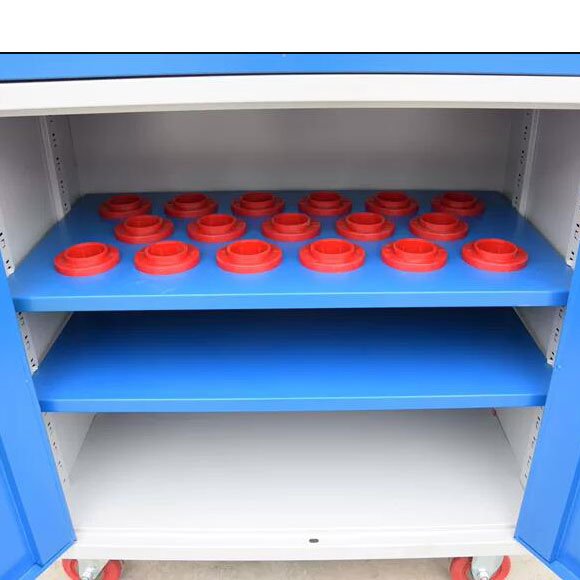
Cold-rolled steel costs more for two reasons. The material itself. And the welding. Cold-rolled steel needs a skilled hand to weld properly — joints have to be solid or the cabinet won’t survive years of pushing around. You can’t cut corners on either and keep the price low. But look back in three years. The cheap cabinet’s been replaced twice by then.
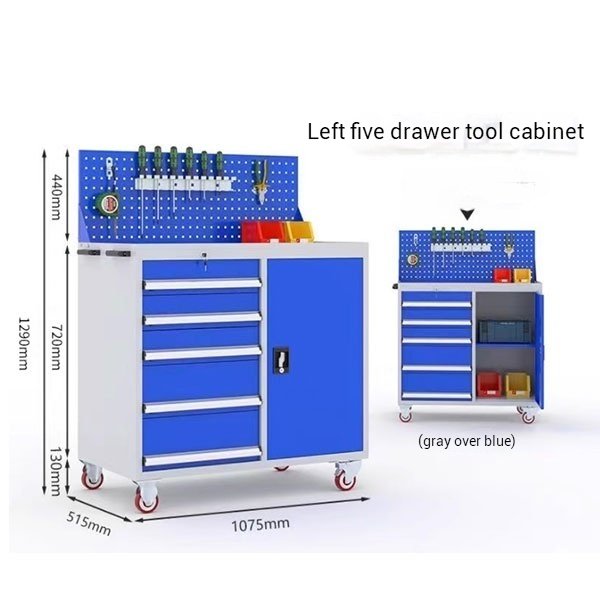
Rolling Tool Cabinet for Auto Repair Shops——Drawers, Pegboard, Locks — Three Details That Decide How It Feels to Use
A mechanic’s tools aren’t one size. Wrenches, sockets, screwdrivers, Allen keys, torque wrenches, multimeters — different shapes, different depths. Good cabinets use graduated drawers: shallow for everyday hand tools, medium for power tools and gauges, deep for air tools and bulk. Shove everything into one drawer size and you spend more time hunting than working.
Then the pegboard. A cabinet with a pegboard and one without are two different tools. Hang the wrenches and sockets you use every hour on the board, grab them without bending down. Add parts bins and the small stuff — screws, washers, clamps — stays sorted and visible. We’ve supplied a lot of shops over the years, and almost everyone who buys a second cabinet adds the pegboard. The ones who skipped it the first time regret it within six months. A mechanic bends down hundreds of times a day. Every motion the pegboard saves is real time.
Then the lock. It’s not just about outsiders. It’s about tools not walking off. When a mechanic breaks for lunch and the shift ends, tools left loose mean tomorrow starts with a hunt. Lockable drawers mean each mechanic’s daily tools stay where they left them. Brass-core locks outlast standard ones — shops are dusty and oily, and a regular cylinder gets sticky within six months. Brass holds up.
A Quick Checklist Before You Buy
- Wheels must have brakes. A cabinet without brakes rolls away on a sloped floor. You might not have seen it happen. I have.
- Drawers should have liners. Without rubber liners, tools clang against bare steel and get scratched.
- The push handle matters. Too low or too narrow, and your back pays for it. Around 90–100 cm feels right — no bending.
- Color is not cosmetic. Dark cabinets swallow tools in a dim shop. Light blue or blue-grey beats all-black when you’re hunting for a 10mm socket.
- Ask about spare parts. Pegboard hooks, bins, shelves — can you buy them separately later? If not, buy the cabinet complete up front.
FAQ
- MOQ? 1 unit. Bulk pricing negotiable.
- Quote turnaround? Within 24 hours. Tell us how many bays, what tools, and whether you need a pegboard — the quote gets accurate.
- Warranty? 1 year. Normal-use issues, contact us directly.
- OEM/ODM? Yes. Silk-screen logos, custom colors, custom packaging.
- Lead time? 7–15 days standard, 20–30 days custom.
- Packaging? Moisture film plus corner protectors, packed by component. Arrives rust-free and dent-free.
- Certification? CE certified.
Want to talk configuration and pricing? Contact us — we reply within 24 hours. Browse our rolling tool cabinet lineup first if you want the spec sheet.
Luoyang Hengna Office Furniture Co., Ltd. — 9 years of steel storage for export markets.